
The Q1 2026 10-Q has a segment table most earnings coverage skipped. What it shows changes how you think about what Domino’s actually sells.
The 60-second version
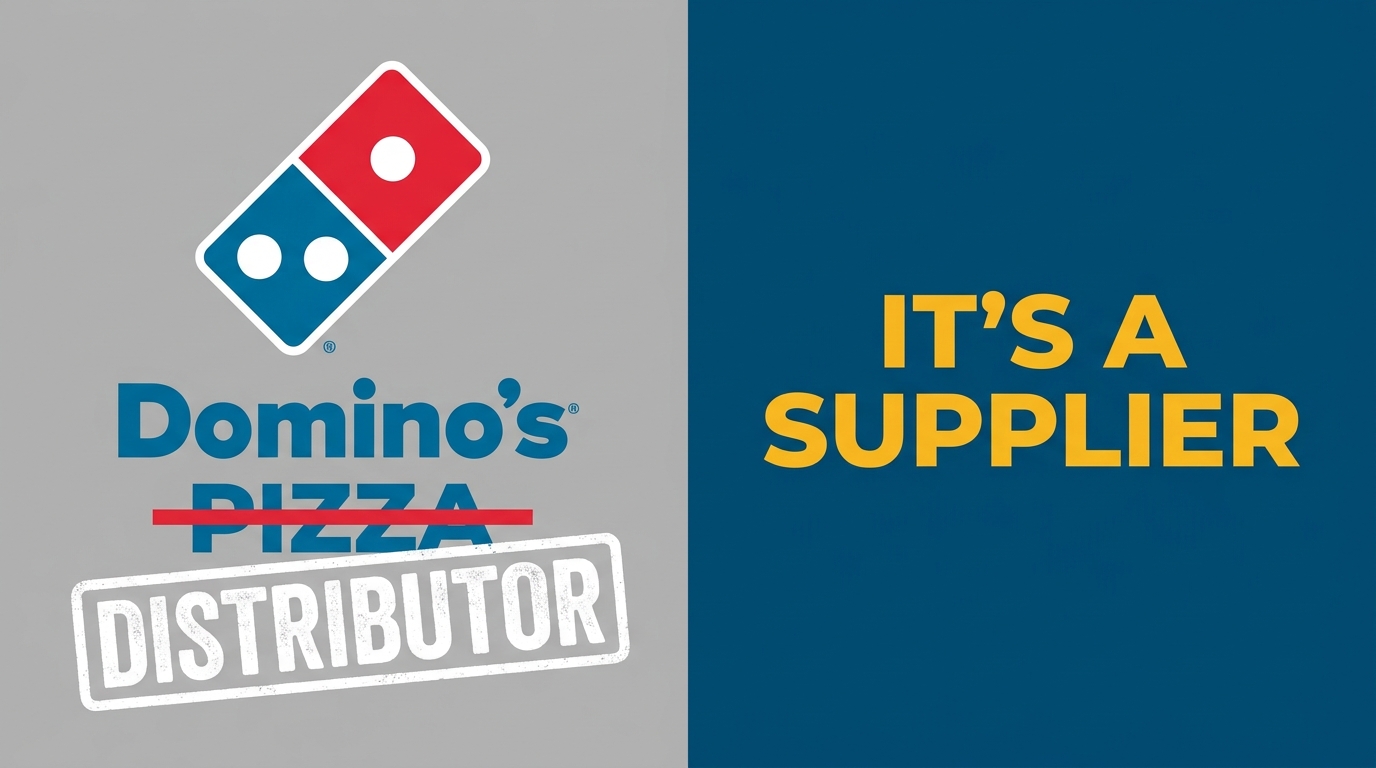
Domino’s reported Q1 2026 earnings on April 27, 2026. Same-store sales were up 0.9%, the stock fell about 7%, and the coverage moved on. But the company’s segment table, sitting in the 10-Q filed the same day, shows something the headlines didn’t mention: the single largest revenue line at Domino’s is not pizza. It’s the dough, cheese, sauce, and supplies the company sells to its own franchisees through a network of regional dough-manufacturing centers. That line came to $724.4 million in Q1 2026, against $82.1 million for company-owned stores and $158.0 million for U.S. franchise royalties. In fiscal 2024, the supply chain segment was $2.85 billion, roughly 60% of consolidated revenue. This pattern holds every year, by a wide margin, and it has for years. Why it matters, what it means for the franchise model, and why the stock-drop story and the business story are almost entirely unrelated. That’s what this piece covers.
What the Domino’s earnings coverage actually said
When Domino’s reported Q1 2026 results, the headlines organized themselves around two numbers. U.S. same-store sales up 0.9%, and the stock down about 7% on the day.
Both of those things are true. Neither of them is the most important thing in the filing.
Same-store sales is the metric the quick-service restaurant industry runs on. It measures how much more, or less, money existing locations are making compared to the same period a year ago. It’s a clean, comparable, one-number read on whether the brand is pulling customers in. Investors and analysts watch it closely, cover it consistently, and use it as the primary signal for whether a fast-food company is healthy.
The problem with using it as the primary signal for Domino’s is that it describes only one piece of how Domino’s makes money. And it’s not the biggest piece.
The 10-Q filed alongside the earnings release contains a segment revenue breakdown that tells a structurally different story from the same-store-sales line. Reading it takes about three minutes. Almost no mainstream coverage did.
That gap between the press-release story and the filing story is not unusual in corporate earnings coverage. Earnings releases are written to emphasize what management wants you to read. The 10-Q is filed because the SEC requires it. The two documents have different authors, different audiences, and very different incentives behind what they highlight and what they let sit quietly in a table. Same-store sales appeared in the Domino’s Q1 2026 press release. The segment revenue breakdown, with its supply-chain-leads-everything structure, did not. Both are truthful representations of the quarter. Only one was designed to be found.
How Domino’s revenue actually breaks down (Q1 2026)
The segment table in Domino’s Q1 2026 10-Q (SEC EDGAR, accession dpz-20260322, fiscal quarter ended March 22, 2026) shows total consolidated revenues of $1,150.6 million. That revenue comes from five lines:
- Supply chain: $724.4 million
- U.S. franchise royalties and fees: $158.0 million
- U.S. franchise advertising: $130.5 million
- U.S. company-owned stores: $82.1 million
- International franchise royalties and fees: $81.0 million
Supply chain is the largest line by a significant margin. It’s 4.6 times the franchise royalty line and nearly nine times the company-owned store line. If you add up every non-supply-chain line and put it next to supply chain, supply chain is still the bigger number.
One technical note worth knowing: the $724.4 million is the gross supply chain revenue line as it appears in the segment table. After eliminating $25.4 million of intersegment sales (supply chain selling ingredients to Domino’s own company-owned stores, which nets out in consolidation), the segment’s reported revenue comes to $699.0 million. Both numbers are in the same table. The gross line is what the supply chain operation actually generated before internal accounting removes the sales-to-self. Either way, the supply chain segment is the single largest contributor to Domino’s revenue.
This isn’t a Q1 anomaly. In fiscal 2024, the supply chain segment contributed approximately $2.85 billion to consolidated revenues, or roughly 60% of the total. The year before that, the same structure. The year before that, the same. Domino’s has been a food-distribution business with a pizza brand on the front for longer than most of its coverage would suggest.
The proportions are worth internalizing. Add together every revenue line that has something to do with pizza reaching a customer: company-owned store sales ($82.1 million) plus U.S. franchise royalties ($158.0 million) plus U.S. franchise advertising ($130.5 million) plus international royalties ($81.0 million). That’s $451.6 million. The supply chain line alone is $724.4 million. The company earns more from manufacturing and distributing ingredients than from every other activity combined, including royalties from roughly 22,000 stores, advertising fees, and the revenues from its own locations. The structure the same-store-sales coverage consistently misses isn’t hidden. It’s in the segment table two clicks deeper than the earnings release.
What “supply chain” actually means at Domino’s
The supply chain segment is not a logistics operation that moves boxes around. It’s a manufacturing and distribution business that Domino’s runs in parallel with the franchise network.
Here’s how it works. Domino’s operates a network of regional dough manufacturing and supply chain centers across the U.S. and in several international markets. These facilities make fresh dough, and they supply franchise stores with the full range of ingredients and materials they need to operate: flour, cheese, sauce, vegetable toppings, meats, packaging, and equipment. The stores place orders, the facilities produce and ship, and Domino’s recognizes revenue on the sale.
The franchise contract is the mechanism that makes this work. When someone buys a Domino’s franchise, the agreement requires them to source their food and supplies through Domino’s distribution network. They don’t have the option to negotiate with a competing cheese supplier or find a cheaper flour source. The contract specifies where the inputs come from. Every franchise store is, from the perspective of the supply chain segment, a captive customer.
This creates a business dynamic that looks very different from a typical restaurant chain. A normal quick-service brand earns royalties (a percentage of store sales) and whatever its company-owned locations bring in. Domino’s earns those things too, but the biggest stream is the margin on every ingredient that moves through its supply centers to its franchisees. The brand isn’t just marketing. It’s a customer-acquisition system for a distribution network.
The franchise model and why the captive buyer matters
The roughly 22,000 Domino’s stores operating worldwide as of early 2026 are almost entirely franchised. About 99% are franchise-owned; Domino’s ran approximately 262 company-owned U.S. stores during Q1 2026. That ratio is the operating leverage underneath the supply chain business.
Every time a new franchise store opens, the supply chain segment acquires a new captive account. That store will order dough and cheese on a regular schedule, under a contract that prevents it from going elsewhere. It won’t leave unless it closes. It won’t renegotiate the sourcing arrangement. It contributes a reliable, recurring volume of ingredient purchases for as long as it operates.
Domino’s added 180 net new stores in Q1 2026 alone. Each one added to the base of locked-in accounts the supply chain serves. When the company talks about store-count growth, it’s simultaneously describing customer-base growth for its distribution business. The two things are the same thing, described differently.
Think about what that compounding looks like over time. At 180 net new stores per quarter, the account base is growing by hundreds of captive buyers every three months. Each new store begins placing regular ingredient orders, under a contract that prevents it from switching suppliers, for as long as it operates. Unlike a conventional distribution business, Domino’s doesn’t have to pitch for those accounts, negotiate pricing against competitors, or risk attrition to a rival. The growth is structural, embedded in the franchise expansion plan the company publishes in its guidance.
The dough-manufacturing network is the physical infrastructure that makes this scale. Domino’s operates dough centers that produce fresh dough on tight timelines, since fresh dough has a short shelf life and needs to reach stores within a specific window for quality to hold. That manufacturing constraint creates a regional supply-chain logic that a competitor would find difficult to replicate quickly. A new entrant couldn’t offer Domino’s franchisees an alternative supply source without building out a parallel manufacturing and cold-chain infrastructure. The franchise contract removes the demand side of that equation anyway, but the supply-side infrastructure is its own competitive barrier.
This is also why the supply chain margin matters more than same-store sales as a read on the business’s profitability trajectory. Same-store sales can soften because of weather, a competitor promotion, a slow consumer spending environment, any number of external factors. The supply chain margin reflects something more structural: how well Domino’s is managing its input costs (cheese, wheat, packaging) relative to the prices it charges franchisees. In Q1 2026, that margin came in at 12.2%, up from the prior year, driven by better procurement pricing. The most profitable part of Domino’s got more profitable in a quarter when same-store sales barely moved.
Why the stock fell, and why it had nothing to do with the business
The Q1 2026 stock reaction (down roughly 7% on earnings day) generated the impression of a bad quarter. The operating results don’t support that reading.
Operating income rose 9.6% year over year, to $230.4 million. Cash from operations for the quarter was $162.0 million. A restaurant chain with 0.9% same-store-sales growth doesn’t typically generate those numbers. A food distributor with 22,000 captive accounts and a 12.2% supply-chain margin does.
So why did net income fall? From $149.7 million a year ago to $139.8 million this quarter, a drop of about $10 million.
The answer is one line item, and it’s not operational. Domino’s owns an equity stake in DPC Dash, its publicly traded master franchisee in China. Under current accounting rules, that holding gets marked to market every reporting period, and the change in value flows directly through the income statement. A year ago, the DPC Dash mark contributed a $24.0 million gain to reported income. In Q1 2026, it contributed a $6.0 million loss. A swing of $30 million, driven entirely by the movement of a stock Domino’s happens to hold, with no connection to how many pizzas were sold, how much dough moved through the supply centers, or what the margin looked like.
The business got stronger. The reported profit got weaker. Those two things don’t contradict each other; they’re just measuring different things. The operating income and cash flow numbers describe the business. The net income number in Q1 2026 describes the business plus the mark-to-market movement of a Chinese affiliate’s share price. Conflating them is exactly how you get a narrative about a bad quarter that the segment table doesn’t support.
This dynamic will repeat every quarter Domino’s holds the DPC Dash stake and marks it to market. In quarters where DPC Dash’s share price rises, Domino’s reported net income will be flattered by a non-cash gain with no connection to ingredient sales, royalties, or pizza. In quarters where it falls, net income will be depressed by a non-cash loss for the same reason. A reader who tracks only headline net income will get a different quarter depending on which direction the mark went, and may draw the wrong conclusion either way.
The more reliable read is to start with operating income ($230.4 million, up 9.6%) and cash from operations ($162.0 million) before introducing the DPC Dash effect. On those two measures, Q1 2026 was a quarter where the supply chain held its margin, store count grew, operating profit rose nearly 10%, and cash generation stayed strong on flat consumer demand. That’s not a bad quarter by any operational measure. It’s a quarter where a mark-to-market entry on a Chinese affiliate’s stock produced a reported-income figure that didn’t reflect what the underlying business actually did.
The intersegment detail most readers missed
There’s a smaller number in the same table that’s worth examining on its own terms, because it illustrates the same thesis more precisely than any of the headline figures.
The “Supply chain” revenue line in the Q1 2026 segment table reads $724.4 million gross. The supply chain segment’s revenues after eliminations read $699.0 million. The $25.4 million difference is intersegment sales: supply chain selling ingredients to Domino’s own company-owned stores, which gets eliminated when the consolidated financials are prepared.
Under accounting rules, a company can’t book revenue from selling something to itself in consolidation. So the $25.4 million that the supply chain segment earned by selling dough and cheese to Domino’s own 262 U.S. locations gets removed before the consolidated revenue figure is reported.
What that footnote-level detail reveals is the degree to which distribution is the central operating model, not just a service the company provides to outsiders. Domino’s company-owned stores are not just stores. They’re also customers of the supply chain segment. The internal supply operation is large enough, and integrated enough, that the company has to eliminate $25.4 million of sales-to-self in a single quarter just to get to an accurate consolidated revenue number.
That’s not a rounding error. It’s structural. It says the manufacturing and distribution operation feeds every part of the enterprise, including the parts Domino’s owns directly. Strip away the accounting elimination and the supply chain segment generated over $724 million in a single quarter selling flour and cheese. To franchisees. To its own stores. To anyone in the system who needed ingredients.
How to find this in the actual Domino’s 10-Q
The segment table that shows all of this is not buried. It’s in the quarterly 10-Q filing available on SEC EDGAR under Domino’s CIK (0001286681). The Q1 2026 filing uses the accession number dpz-20260322, and the segment revenue breakdown appears in the notes to the condensed consolidated financial statements, in the section titled “Segment Information.”
The table lists five revenue lines (Supply chain, U.S. franchise royalties and fees, U.S. franchise advertising, U.S. company-owned stores, and International franchise royalties and fees), along with each segment’s income from operations. Below the individual line items, there’s a reconciliation row showing intersegment eliminations, which is where the $25.4 million discussed above appears. Total revenues then reconcile to the $1,150.6 million consolidated figure on the income statement.
The income-from-operations breakdown in the same table is also worth reading alongside the revenue figures. It shows what each segment actually contributes to profit, not just to revenue. The supply chain segment’s operating income in Q1 2026 was $88.1 million. The U.S. stores segment (combining company-owned stores and franchise royalties) contributed the majority of the remaining income. But the key observation is that the segment generating the most revenue, supply chain at $724.4 million, is also generating substantial profit, at a 12.2% margin, in a quarter when the consumer-facing business was essentially flat.
The cash flow statement is the third document worth pulling alongside the income statement and the segment table. Cash from operations at $162.0 million tells you what actually came in the door, after working capital movements and real cash outlays, rather than what the accounting income statement records after non-cash items like the DPC Dash mark. For a business with the kind of capital structure Domino’s runs, cash from operations is the number that services the debt. At $162.0 million in a single quarter on 0.9% same-store-sales growth, the distribution model is doing what a distribution model is supposed to do.
How this compares to other franchise restaurant models
Most franchise-heavy restaurant businesses earn in two ways: royalties (a percentage of franchisee sales, typically 4–6% of revenue) and whatever the company’s own locations contribute. The royalty stream is high-margin and capital-light. The company-owned stores require capital investment but demonstrate the brand and generate operating data.
Domino’s does both of those things, but the supply chain adds a third stream that most franchise models don’t have at scale. McDonald’s, for example, earns royalties and owns significant real estate that it leases back to franchisees; its real-estate model is well-documented. Yum Brands (Pizza Hut, KFC, Taco Bell) runs a more conventional royalty-and-fee franchise structure. Domino’s built a manufacturing and distribution operation that sits between the brand and the franchisee, and it monetizes every input that moves through it.
The comparison matters because it explains why Domino’s cash flows look the way they do, and why a same-store-sales lens understates the stability of the business. In a pure-royalty franchise model, every dip in store-level sales translates directly into a proportional dip in royalty income. There’s nowhere else to look. Domino’s has a second lever: the supply chain earns on ingredient volume, not sales volume. A franchisee who sells fewer pizzas in a slow week still orders roughly the same ingredient inputs the following week to stock for the next one. The relationship between consumer demand and supply-chain revenue is real but indirect, buffered by the ordering cycle and the store’s need to maintain inventory.
Royalties and supply-chain margins on captive accounts are both recurring, contract-backed streams. The company has run a heavily leveraged balance sheet for years, returning cash to shareholders aggressively, and the ability to service that debt rests on the predictability of those streams. A consumer slowdown that pressures same-store sales will ripple through the royalty line eventually. It ripples through the supply chain line only if stores start closing, which is a much higher bar. Closing a franchise store is an expensive, contractually complicated event. Same-store sales can move around on soft quarters without triggering closures. The supply chain revenue base is stickier than the royalty base, which is itself stickier than company-owned store revenues. Domino’s has three layers of revenue, and the most durable one is the largest.
The risks to the distribution-company thesis
The framing above is the bullish read on how Domino’s is actually structured. It comes with real risks worth naming.
Franchisee financial health is the floor. The supply chain business generates revenue only as long as franchise stores stay open and ordering. If franchisee economics deteriorate (thin margins, rising lease costs, soft consumer traffic), store closures eventually compress the captive account base. The captive buyer is only captive while the store operates. A wave of franchise closures is the scenario where the supply chain framing stops being a tailwind.
Input cost volatility can compress the margin. The 12.2% supply chain margin in Q1 2026 benefited from favorable commodity pricing. Cheese and wheat are volatile. A sustained rise in either compresses the spread between what Domino’s pays for ingredients and what it charges franchisees, since the pricing to stores isn’t immediately adjustable. The margin can move in both directions, and the supply chain segment’s profitability is more exposed to commodity markets than the royalty line is. When cheese prices spiked in prior commodity cycles, the supply chain margin compressed. The royalty stream, which is a fixed percentage of store sales, doesn’t shrink when input costs rise. The margin risk in the business is concentrated in the segment that generates most of the revenue, which means a commodity downturn hits Domino’s harder than it would a pure-royalty franchise model.
Same-store sales do matter, eventually. At some order-volume floor, franchisees start questioning the economics of staying open. Very weak same-store sales for long enough threaten the captive-account base. The distribution framing doesn’t make same-store sales irrelevant; it makes them a lagging rather than leading indicator of supply-chain health.
The DPC Dash stake will keep creating noise. As long as Domino’s holds the China stake and marks it to market, reported net income will swing with DPC Dash’s share price. In quarters where that mark is a significant negative, the headline number will understate operating performance. In quarters where it’s a positive, it will overstate it. Investors reading only net income will keep misreading the business.
International franchise royalties are growing. At $81.0 million in Q1 2026, international franchise fees are the smallest line in the segment table. But the international store base is large and growing. If that line scales significantly, the supply-chain percentage of total revenue could compress somewhat, even if supply-chain revenues keep growing in absolute terms.
What to watch in the next 12 to 24 months
Supply chain margin trajectory. This is the number that matters most and gets covered least. If it holds above 12% while same-store sales stay flat, the thesis strengthens. If it compresses on commodity pressure while orders stall, the operating story changes.
Net new store count. Every store that opens is a new captive account. Every store that closes removes one. The net-new figure in each quarterly 10-Q is a direct read on whether the supply chain’s customer base is growing or contracting.
Franchisee profitability disclosures. Domino’s publishes average unit volumes and franchisee financial data in its filings. Deterioration in franchisee-level economics is the early warning signal for the main risk to the supply chain model.
DPC Dash and the mark-to-market. Watch whether the China stake grows, shrinks, or gets sold. A disposal would remove the earnings noise permanently. A continued mark will keep distorting reported net income, in both directions.
International supply chain expansion. Domino’s has been building supply chain infrastructure in international markets. If the model extends internationally at scale, the supply chain share of total revenue could expand further, even as international franchise royalties grow.
Domino’s biggest product was never the pizza. It’s the flour, the cheese, and the box, sold to the only customers who aren’t allowed to buy them anywhere else.
Sources: Domino’s Pizza Q1 2026 10-Q, SEC EDGAR (accession dpz-20260322, fiscal quarter ended March 22, 2026, filed April 27, 2026). Domino’s Pizza FY2024 10-K (accession dpz-20241229). All segment figures cited directly from SEC filings.
Frequently asked questions
What percentage of Domino’s revenue comes from supply chain?
In Q1 2026, the gross supply chain revenue line was $724.4 million against total consolidated revenues of $1,150.6 million, roughly 63% of the total before intersegment eliminations. After eliminations, the segment’s reported revenues were $699.0 million, or about 61%. In fiscal 2024, the supply chain segment was approximately $2.85 billion, or roughly 60% of consolidated revenue. The proportion has been broadly consistent in this range for several years.
How does Domino’s supply chain business work?
Domino’s operates regional dough manufacturing centers and supply chain facilities that produce fresh dough and distribute ingredients, packaging, and equipment to franchise stores. Franchise agreements require stores to source supplies through this network, making every franchisee a captive customer of the supply chain segment. The segment earns revenue on the markup between what it pays for ingredients and what it charges stores.
Why did Domino’s stock fall after Q1 2026 earnings?
The stock fell roughly 7% on the day Q1 2026 results were reported, primarily because net income declined year over year, from $149.7 million to $139.8 million. The decline was driven mainly by a $30 million swing in the mark-to-market value of Domino’s equity stake in DPC Dash, its China master franchisee, which went from a $24.0 million gain in the prior-year quarter to a $6.0 million loss in Q1 2026. Operating income rose 9.6% in the same quarter.
Is Domino’s a franchise business or a food distributor?
It’s both, and understanding the split is key to reading its financials correctly. Domino’s earns franchise royalties (U.S. franchise royalties and fees were $158.0 million in Q1 2026), income from its own stores ($82.1 million), and supply chain revenues from selling ingredients to franchisees ($724.4 million gross). The supply chain line is the largest of the three, which makes the distribution operation the single biggest driver of Domino’s revenue, ahead of both royalties and company-owned store income.
How does Domino’s make money on the supply chain if it’s selling to its own franchisees?
The supply chain segment earns a margin on the spread between input costs and the prices it charges stores. In Q1 2026 that margin was 12.2%. The model works because Domino’s buys ingredients at scale (giving it purchasing leverage on commodity prices) and sells to a captive customer base at a markup that reflects the value of its distribution network, the freshness of its dough, and the terms of the franchise agreement. Franchisees are contractually required to source through the network, so the segment doesn’t compete for business the way an independent distributor would.
What is DPC Dash and why does it affect Domino’s earnings?
DPC Dash is Domino’s publicly traded master franchisee in China. Domino’s holds an equity stake in the company, which it marks to market every quarter under current accounting standards. The change in fair value flows through Domino’s income statement as a gain or loss. In Q1 2026 it was a $6.0 million loss, compared to a $24.0 million gain in Q1 2025, a $30 million swing that directly reduced reported net income without reflecting any change in Domino’s operating performance.