
Costco sold $69 billion of merchandise last quarter and kept almost none of it. The real profit sits one line further down the filing, and the company barely bothers to hide it.
The 60-second version
Costco reported $69.15 billion in net sales for its fiscal third quarter of 2026, and the profit it earned on all of that merchandise rounds to almost nothing. The company keeps roughly 11 cents of gross margin on each dollar of goods, less than half what Walmart or Target keep, and then spends most of those cents running the warehouses. The famous cheap prices, the $1.50 hot dog and the $4.99 rotisserie chicken, are not loss leaders in the ordinary sense; they are held below cost on purpose, and the reason is not generosity. The actual profit comes from a single recurring line that most shoppers never think about when they load the cart. This article opens the filing and shows exactly where the money is, why the cheap food protects it, and what would have to break for the model to stop working.
Skip to the section that interests you most
How does Costco make money? The short answer
Costco makes money by charging people an annual fee to shop there, and then selling them merchandise at close to cost. That is the entire model in one sentence. The warehouse, the pallets, the treasure-hunt layout and the food court all exist to make the annual fee feel worth renewing, which the overwhelming majority of members do.
Most explanations of Costco get the causation backwards. The common version says Costco is profitable because it buys in vast volume, accepts thin margins, and makes it up on turnover. Volume and thin margins are real, but they are not where the profit lands. Strip the membership fee out of Costco’s results and the profit from selling $69 billion of goods nearly disappears. The fee is not a nice supplement to a retail business. The fee is the business, and the retail is the customer-acquisition cost.
The rest of this piece walks through the numbers from Costco’s most recent SEC filing, its Form 10-Q for the quarter ended May 10, 2026, filed June 3, 2026. Every figure below comes from that document unless noted otherwise.
The $69 billion that barely earns a profit
Start with the top line, because it is genuinely large. Costco reported net sales of $69.15 billion for the twelve weeks ending May 10, 2026, up 11.6 percent from the same quarter a year earlier. Net income came to $2.19 billion, up 15 percent. On the surface this is a clean, strong quarter, and most of the financial press covered it exactly that way.
Now read one line down. Against $69.15 billion of net sales, Costco’s merchandise costs were $61.52 billion. The difference, the gross margin, works out to about 11 percent. That is the money left after paying for the goods but before paying for anything else: the warehouses, the wages, the electricity, the forklifts, the accounting department.
Eleven percent is a remarkable number for a retailer of this size, and not in a flattering way. It means Costco chose to keep less than half of what its direct competitors keep on every dollar of goods sold. This was not forced on the company. Costco could raise prices tomorrow. It has decided, deliberately and for decades, not to.
Then the eleven cents has to cover operating costs. Costco’s selling, general and administrative expenses ran close to nine percent of sales. Subtract that, and the merchandise itself contributes almost nothing to the bottom line. The goods move $69 billion in and roughly $69 billion back out, and the profit on them, after the building does its work, is a sliver.
A retailer that ran this way by accident would be in trouble. Costco has run this way on purpose since the 1980s, which is the first clue that the store was never designed to be where the money is made.
The membership fee is the actual profit engine
Here is the line the headline coverage tends to skip. In the same quarter, Costco collected $1.37 billion in membership fees. That is money members pay for the right to walk in the door, and it is a record, up 10.7 percent year over year.
Set that fee number next to the profit number. Membership fees were $1.37 billion. Total net income, after every cost and every tax, was $2.19 billion. The fees alone equal roughly two-thirds of everything Costco earned in the quarter. For every three dollars of profit the company reported, two dollars of it can be traced directly to the card, collected before anyone bought a single item.
Run the arithmetic from the other direction and it is starker still. Costco’s operating income for the quarter was $2.82 billion. Remove the $1.37 billion of membership fees, and the entire selling operation, all $69 billion of merchandise, produced about $1.4 billion of operating income. The fee, which costs Costco almost nothing to collect, nearly matched the profit from the whole rest of the company.
The reason the fee is so powerful is that it is almost pure margin. A membership fee has no cost of goods. No truck delivers it, no freezer preserves it, no worker restocks it. A card scans at the entrance and the dollar flows through to profit with almost nothing subtracted. Nothing on a Costco shelf can compete with an income stream that has no expenses attached, and management knows it.
Costco does not publish a standalone profit figure for merchandise, and it does not need to. The structure is legible from the lines it does disclose. The goods are sold at roughly break-even; the fee carries the earnings. When people ask how Costco makes money, this is the answer in a single comparison: the fee is about two-thirds of profit, and the store exists to sell the fee.
It helps to see the fee as the one line on Costco’s income statement with no matching cost line beneath it. Every other dollar of revenue drags a cost behind it. Merchandise revenue drags $61.52 billion of merchandise cost. Even the gasoline and ancillary businesses carry their own cost of sales. The membership line stands almost alone, a stream of high-margin cash whose only real expense is the marketing that keeps members renewing, and that marketing is largely the cheap food already accounted for elsewhere. In accounting terms, the fee is close to the cleanest profit a large company can report.
This is also why Costco’s earnings are far more predictable than a typical retailer’s. A conventional store lives and dies on merchandise margin, which swings with freight costs, promotional intensity, theft, and consumer mood. Costco has quietly moved the bulk of its profit onto a line that is contracted a year in advance and renewed at better than nine in ten. The company took the least predictable part of retail, the margin on goods, and made it nearly irrelevant to the bottom line, replacing it with a subscription that behaves like clockwork. Investors pay a premium multiple for that predictability, and the fee is the reason it exists.
The $1.50 hot dog and the $4.99 chicken are marketing, not food
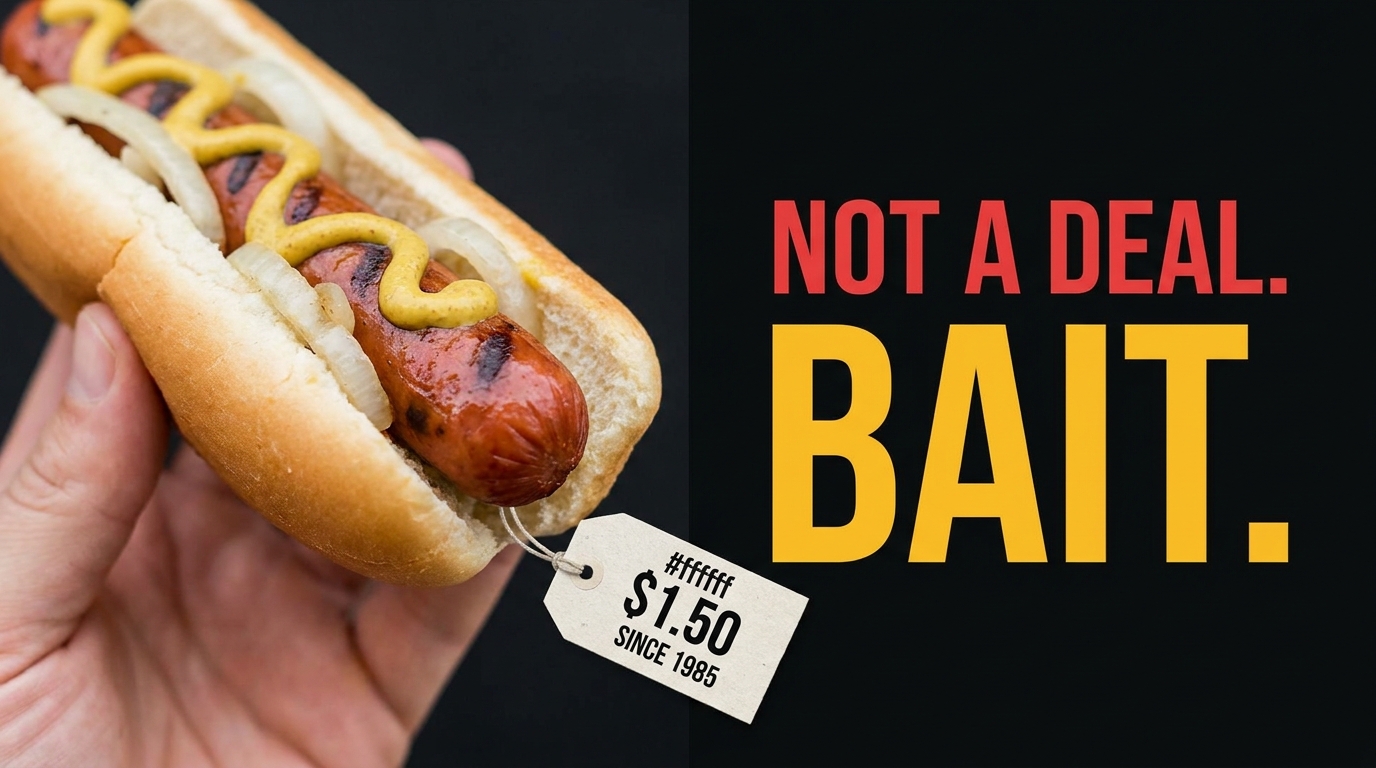
The most famous facts about Costco are its prices. The hot dog and soda combo has cost $1.50 since 1985. The rotisserie chicken has cost $4.99 since 2009. Both are priced below what it costs to make and sell them, and both have stayed frozen through decades of inflation that touched everything else in the building.
Run the hot dog through the government’s own inflation math and the same $1.50 combo from 1985 would cost around $4.50 today. Costco absorbs that gap on more than 100 million combos a year. The chicken is the more revealing case. When poultry costs threatened the $4.99 price, Costco did not raise the tag. It spent roughly $450 million building its own poultry operation in Nebraska, complete with its own farms and feed mill, processing around two million birds a week, specifically so the price could stay at $4.99. Faced with rising chicken prices, most companies raise prices. Costco raised chickens.
The company’s longtime chief financial officer once told analysts that holding the chicken at $4.99 costs Costco somewhere between $30 and $40 million a year in profit it chooses not to take. He said it approvingly, the way another executive might announce a dividend. That is the tell. A company does not brag about a $40 million annual loss unless the loss is buying something more valuable.
What it buys is traffic and loyalty, which are the inputs to renewal. The cheap food is not a charitable quirk sitting oddly next to a profit-maximizing business. It is a line item in the marketing budget, delivered at the food court and the rotisserie counter, and its job is to remind every member, on every visit, that the annual fee was a smart decision. Seen that way, the hot dog is one of the most efficient customer-retention tools in retail, and $1.50 is a bargain for Costco, not for you.
Pricing authority: why Costco freezes prices on purpose
Costco has a name for what the frozen prices are doing, and it is written into the filing. In its management discussion, the company describes a goal of maintaining what it believes is a member perception of its “pricing authority.” Translated out of corporate language, pricing authority means the member trusts that Costco’s price is the lowest available and stops checking. That trust is the whole asset. A member who no longer comparison-shops is a member who renews on autopilot.
The same logic runs through the parts of the business that look like giveaways. Costco’s gasoline is priced aggressively low, and the filing is candid that the cheap gas exists to drive traffic into the warehouse rather than to earn a margin at the pump. The pattern repeats: find a category people check prices on, win it decisively, and use the resulting trust to keep them inside the membership.
This reframes the strange behavior around the hot dog and the chicken. Freezing a handful of prices for decades is not sentimental, and it is not a stunt. It is the maintenance cost of pricing authority. Costco spends real money holding those prices because the alternative, a member who starts to suspect Costco is just another store, is far more expensive than a $40 million chicken subsidy. The frozen prices are the advertisement, and pricing authority is what the advertisement buys.
The rest of the store is engineered around the same goal. Costco stocks a deliberately narrow selection, often a single option in a category where an ordinary supermarket carries a dozen, which lets it buy each item by the pallet and negotiate a price no smaller retailer can match. The famous treasure-hunt layout, where the seasonal and high-value items move around and sell out, exists to make each visit feel like it might contain a deal too good to miss, which is another way of reinforcing that the membership is worth using. Even the Kirkland Signature private label serves the trust: it is priced below the national brands beside it and, in many cases, made by those same national brands, so members learn that the store-brand choice is not a compromise. Every one of these decisions feeds the same asset, a member who believes Costco’s price is the best available and therefore renews without shopping around.
The strategy has a cost that shows up nowhere on the income statement as a loss but everywhere as forgone profit. Costco could widen its assortment, raise its margins, sell premium shelf placement to suppliers the way most grocers do, and add promotional pricing to squeeze more from each visit. It declines all of it. The forgone margin is the price of pricing authority, paid quietly and continuously, and the membership fee is what makes the trade worthwhile.
The renewal rate and the deferred-fee float
If the fee is the engine, the renewal rate is the fuel gauge, and Costco’s reads almost full. In the United States and Canada, 92.2 percent of members whose membership came up for renewal paid again. Worldwide the figure was 89.7 percent. The US and Canada number ticked up ten basis points from the prior quarter. More than nine in ten members, year after year, choose to keep paying for the privilege of shopping at a store that makes almost nothing selling them goods.
That renewal rate turns the fee from a one-time charge into an annuity, and the filing shows where the annuity accumulates. On the balance sheet, in current liabilities, Costco reports $3.16 billion of deferred membership fees. This is money members have already paid for portions of a membership year that Costco has not yet delivered, so accounting rules classify it as a liability, something the company technically owes.
In practice it is the most dependable money Costco has. It arrives up front, it is renewed at better than nine in ten, and it grew by about $303 million since the end of last summer. Costco holds that balance, earns interest on it, and watches it refill itself every renewal cycle. The filing shows the interest piece directly: interest income for the quarter was $130 million, up from $95 million a year earlier, earned in part on a cash pile that prepaid memberships help keep full. Most retailers borrow money to fund their working capital. Costco’s members fund it in advance, for free, and thank the company at renewal.
The accounting label is almost funny in context. The single most reliable, most profitable, most strategically important pool of money in the entire company sits on the books under the heading of things Costco owes to other people.
The Executive tier: members volunteering to pay more
Underneath the headline renewal rate sits a quieter number that says even more about the model’s strength. Costco’s Executive membership, the premium tier that costs $130 a year against the basic $65, reached 41.2 million members and grew 9.6 percent, roughly twice as fast as the overall paid-member base.
Read that carefully. The expensive tier is growing faster than the cheap one. Members are not merely renewing; a rising share of them are voluntarily upgrading to the version that charges Costco double at the door. The Executive tier hands back a rewards certificate worth two percent of purchases, which members overwhelmingly spend back inside the same warehouse, so the upgrade deepens the relationship on both ends. It costs Costco very little and locks the member in tighter.
This is the behavior of a customer base that does not feel gouged. When a company raises its prices and customers respond by choosing the more expensive option in larger numbers, the company has pricing power most businesses can only envy. The Executive tier is, in effect, millions of members raising their hands to be charged more, which is not a sentence that describes many retailers.
Costco vs Walmart vs Target: the margin comparison
The clearest way to see how unusual Costco’s model is comes from putting its margins next to its competitors. Costco keeps roughly 11 percent gross margin on merchandise. Walmart runs closer to 24 percent, and Target closer to 28 percent, based on their respective most recent annual filings. Costco operates on less than half the gross margin of a conventional big-box retailer, and it does so by choice.
A traditional retailer earns its profit inside that margin. The gap between what the goods cost and what the customer pays is the entire business, so the retailer works to widen it: private-label products, promotional pricing, shelf placement sold to suppliers, everything aimed at capturing a few more points of margin on the goods themselves.
Costco inverts the whole structure. It compresses the merchandise margin toward zero on purpose, uses the resulting low prices to build pricing authority and drive renewals, and captures its profit through the membership fee instead. Walmart makes money when you buy something. Costco makes money when you walk in the door, and treats what you buy afterward as close to a break-even courtesy. It is a fundamentally different business wearing the same warehouse.
There is a detail in this quarter’s margin line that confirms the point. Costco’s gross margin actually slipped, to 11.04 percent from 11.25 percent a year earlier. For a retailer whose profit lived inside the margin, a decline like that would be a concern worth explaining at length. Costco notes it and moves on, because the number that pays the bills, the fee line, was moving the other way. The merchandise margin can drift toward zero and the model holds, as long as renewals hold. That is the clearest possible signal of which number management is actually managing.
So what is Costco, really?
Put the pieces together and the picture is consistent. Merchandise sold at roughly break-even. A fee that equals two-thirds of profit. Cheap food held below cost to protect renewals. A 92 percent renewal rate. A premium tier growing faster than the base. A $3.16 billion float of prepaid fees earning interest on the balance sheet. Every one of these points the same direction.
Costco is a subscription business that happens to operate warehouses. The subscription is the product; the warehouse is the reason the subscription is worth renewing. This is not a contrarian reading imposed on the filing. It is close to what the company says outright. In its management discussion, Costco writes that “the membership format is integral to our business and profitability,” and describes the format as designed to reinforce loyalty and generate continuing fee revenue. The store makes the subscription worth keeping, not the other way around.
None of this is hidden in the legal sense. Every figure here is disclosed in the same filing, on adjacent pages, and analysts have described Costco as a subscription business for years. What the filing rewards is reading it as one connected document rather than a headline. Read that way, the answer to how Costco makes money is not groceries, and it never really was.
The risks to the subscription-warehouse thesis
The reading above is strong, but it is not the only lens, and an honest analysis has to name where it could be wrong or incomplete.
The first challenge is that merchandise is not truly a break-even courtesy. Costco earns real gross profit on goods, around $7.6 billion in the quarter, and that profit funds the operating base the fee sits on top of. Framing merchandise as purely a loss leader overstates the case. A fairer statement is that merchandise covers its own costs and a little more, while the fee provides the profit that would otherwise be thin. The two are entangled, not cleanly separable.
The second challenge is that Costco does not disclose a merchandise-only profit line, so the “goods make almost nothing” claim is a structural inference, not a reported figure. It is well supported by the roughly 11 percent gross margin against roughly nine percent operating costs, but anyone stating it should be clear it is a read of the disclosed numbers, not a line item Costco publishes. Treating it as a hard reported fact would be a mistake.
The third challenge is saturation. The model depends on continued membership growth, and in mature markets like the United States, the pool of new members eventually thins. Renewal rates this high are extraordinary, but they also mean much of the easy growth is already captured. Future fee growth may lean more heavily on price increases than on new members, and price increases test renewal loyalty in a way new-member growth does not.
The fourth challenge is that the fee increase is a lever that can only be pulled occasionally. Costco raises the membership fee roughly every seven years, and this quarter’s record fee income is partly the 2024 increase still flowing through. That is a one-time step up, not a repeatable engine. The next few years will show whether fee income can keep growing at this pace once the 2024 increase is fully lapped.
The fifth challenge is competition for the same wallet. Warehouse clubs and large-format retailers all chase the same value-conscious shopper, and a competitor willing to accept even thinner margins, or a shift in how people shop for bulk goods, could pressure the renewals the whole model rests on. Pricing authority is durable, but it is not permanent.
What to watch in the next one to two years
For anyone tracking whether Costco’s model stays as healthy as it looks today, a handful of specific numbers matter more than the headline sales figure.
Watch the renewal rate, reported every quarter. As long as the US and Canada figure holds around 92 percent, the annuity is intact. A sustained decline, even of a point or two, would be the earliest warning that the cheap food has stopped doing its job of keeping members loyal.
Watch the deferred membership fees line on the balance sheet. That $3.16 billion float is the accumulated evidence that members keep prepaying. If it stalls or shrinks while membership counts are still growing, it would suggest the mix is shifting in ways the headline renewal rate hides.
Watch the timing of the next fee increase. The pattern points to roughly the end of the decade if Costco holds to its seven-year cadence. When it lands, the renewal rate in the quarters immediately after will be the single cleanest test of pricing power the company ever runs: it will show whether members still say yes once the price moves again.
Watch the Executive tier’s growth relative to the base. As long as the premium tier keeps outgrowing the basic one, members are trading up rather than down, which is a sign of a satisfied base. If that reverses, it would hint that value perception is softening.
Watch the gross margin trend on merchandise. A continued gentle slide is consistent with the model and not a concern on its own. A sharp move in either direction would be worth explaining, because it would mean something changed in the balance between the store and the fee.
Costco’s real product is not the merchandise on the shelf but the annual membership that lets you reach it, sold in advance and renewed by more than nine in ten members, and the famously cheap food exists mainly to keep that renewal rate high.
Sources: Costco Wholesale Corporation Form 10-Q for the quarter ended May 10, 2026 (filed June 3, 2026); Costco Q3 fiscal 2026 earnings release and earnings call (May 28, 2026); Walmart and Target most recent annual reports; US Bureau of Labor Statistics CPI data; press reporting from WSJ, CNN and Seattle Times on Costco’s Nebraska poultry operation.
Frequently asked questions
How does Costco make most of its profit?
Costco makes roughly two-thirds of its net income from membership fees rather than from selling merchandise. In its fiscal third quarter of 2026, membership fees were $1.37 billion against total net income of $2.19 billion. The goods themselves are sold at close to break-even after operating costs, so the annual fee is where the profit concentrates.
What is Costco’s profit margin on the products it sells?
Costco’s gross margin on merchandise is about 11 percent, meaning it keeps roughly 11 cents of gross profit on each dollar of goods before paying operating costs. After the cost of running the warehouses is subtracted, the merchandise contributes very little to net profit. By comparison, Walmart and Target operate on gross margins closer to 24 and 28 percent.
Why is the Costco hot dog still $1.50?
The $1.50 hot dog and soda combo has been held at that price since 1985 as a deliberate loyalty tool, not because it is profitable. Costco loses money on it and on other cheap staples like the $4.99 rotisserie chicken. These prices exist to reinforce members’ trust that Costco offers the lowest prices, which keeps renewal rates high, and the fee income from those renewals is the actual business.
How much does Costco make from membership fees?
In its fiscal third quarter of 2026, Costco collected $1.37 billion in membership fees, a record, up 10.7 percent year over year. The company reported 82.9 million paid memberships and 148.5 million cardholders. About a quarter of the fee-income growth came from the membership fee increase Costco implemented in September 2024.
What is Costco’s membership renewal rate?
Costco’s renewal rate was 92.2 percent in the United States and Canada and 89.7 percent worldwide as of the quarter ending May 10, 2026. The US and Canada figure rose slightly from the prior quarter. A renewal rate above 90 percent is exceptionally high and is the foundation of Costco’s fee-based profit model.
Is Costco a retailer or a subscription business?
Financially, Costco behaves more like a subscription business than a traditional retailer. It sells merchandise at close to cost and earns its profit from recurring annual membership fees, which is closer to how a subscription service operates than how a conventional store makes money. Costco itself describes the membership format as integral to its business and profitability.