
A near-free profit engine is being switched off by law, and the quarter that looked like a recovery leaned on things that only happen once. Here is what the filing actually says.
The 60-second version
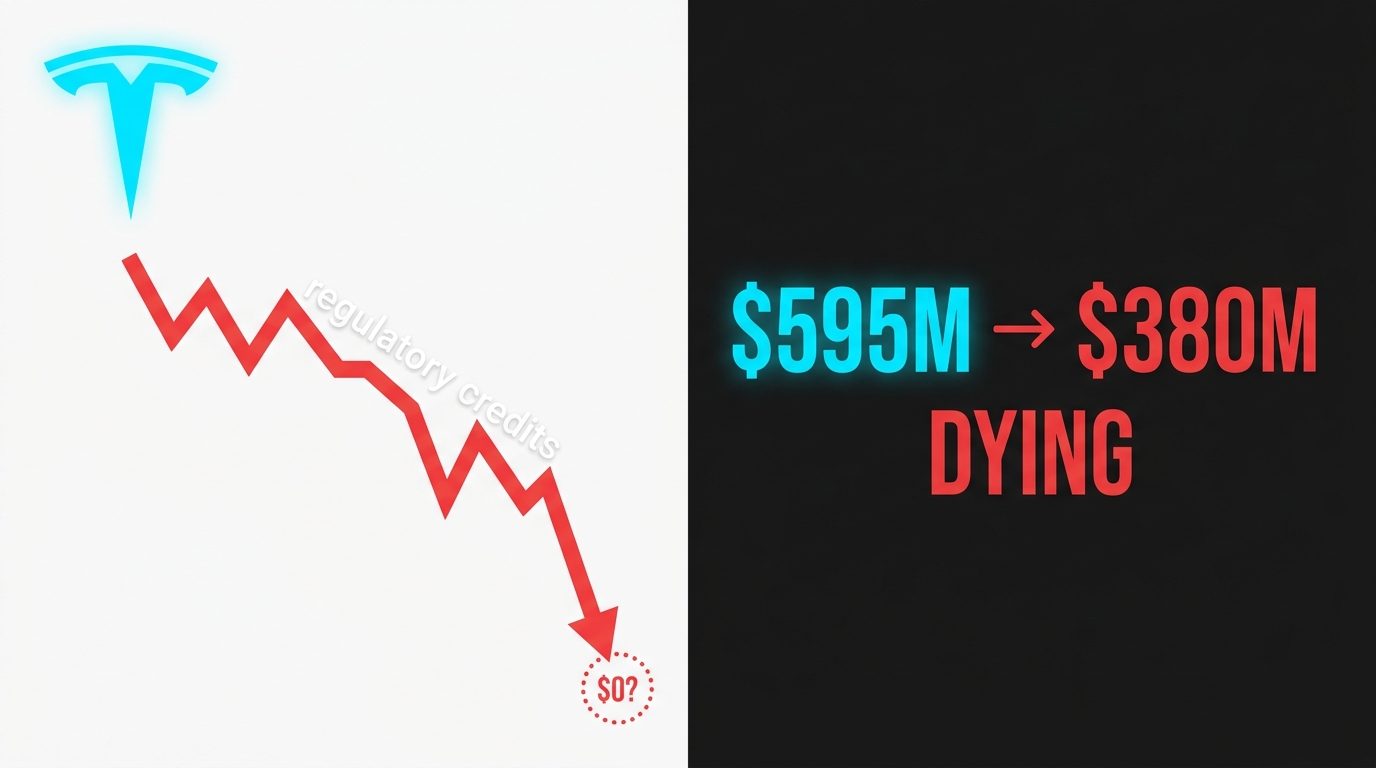
Tesla’s first quarter of 2026 read, on the surface, like a margin recovery: revenue up 16%, operating income up 136%, and a headline profit that beat expectations. Underneath it, the company’s highest-margin revenue line, the regulatory credits it sells to other automakers, fell to $380 million from $595 million a year earlier, the lowest quarterly figure in years. That line carries almost no cost, so its decline erodes profit far more than the topline growth implies. The quarter also relied on one-time benefits that Tesla described but declined to size in dollars. The reason the credits are fading is structural rather than cyclical, and it points to a revenue stream that analysts now expect to approach zero within a couple of years.
Skip to the section that interests you most
What are Tesla’s regulatory credits, exactly?
To understand Tesla regulatory credits, you have to start with the rule that creates them. Governments cap how much a carmaker’s fleet is allowed to pollute. A company that sells too many combustion vehicles breaches the cap and, historically, owed a penalty. There was a way around the penalty: buy a credit from a manufacturer that came in under the limit, and apply it against your own shortfall.
Tesla builds only electric vehicles. It therefore generates these compliance credits automatically, as a byproduct of the cars it was already going to make, and it has far more than it needs. So it sells the surplus to the automakers who fall short. Ford, Stellantis, and others have historically been on the buying side of that trade.
It helps to know there is more than one kind of credit in play. Tesla earns zero-emission-vehicle credits under California’s program and the states that follow it, greenhouse-gas credits at the federal level, and credits tied to CAFE fuel-economy standards. They trade in separate markets with separate rules, but they share the same feature from Tesla’s point of view: the company generates them by doing what it already does and sells whatever it cannot use. Tesla began monetizing that surplus at scale in the mid-2010s, as emissions mandates tightened and legacy automakers found themselves short.
The important detail is not that Tesla sells credits. It is that the credits cost Tesla essentially nothing to produce. A conventional revenue line has a cost of goods sitting behind it: parts, labor, freight. This one barely does. Close to every dollar of credit revenue falls straight through to gross profit. That single characteristic, near-zero cost, is what makes the line worth paying attention to, and it is why a change here moves the bottom line in a way the headline revenue number never reveals on its own.
For years, that quality made regulatory credits one of the cleanest sources of profit any carmaker has ever had. It also made Tesla quietly dependent on a revenue stream that has nothing to do with building better cars.
How much money has Tesla made from regulatory credits?
The scale is easy to underestimate. In 2024, Tesla’s best year for the line, regulatory credits brought in roughly $2.76 billion, with the second quarter alone, at $890 million, the largest single quarter the company has ever booked from them. Full-year 2025 came in lower, around $1.99 billion. Since 2019, the running total is somewhere around $10.6 billion, and because the cost behind it is negligible, most of that figure is profit rather than revenue in the ordinary sense.
The line did not appear overnight. It grew from around $594 million in 2019 to roughly $1.58 billion in 2020, then stair-stepped higher through the early 2020s as more automakers fell short of tightening standards, before peaking in 2024. The 2025 total of roughly $1.99 billion was the first clear step down from that peak. The first quarter of 2026 continues the descent.
To see how load-bearing the line has been, the cleanest illustration is the first quarter of 2025. Tesla reported $399 million in operating income that quarter against $595 million in regulatory credits. Take the credits out, and the quarter turns into an operating loss. The thing keeping the company above the line that period was not the cars. It was the compliance allowances that other automakers were required to buy.
That is the context that makes this year’s number worth reading closely. A stream this large, this profitable, and this central to reported earnings does not shrink quietly without consequences downstream. And it is shrinking.
Is Tesla profitable without regulatory credits?
This is one of the most common questions about the company, and the honest answer is that it depends on the quarter, which is exactly the problem.
Go back to 2020, the year Tesla reported its first full year of GAAP profit. Net income came in at roughly $721 million. Regulatory credits that year were about $1.58 billion. Subtract the credits and the milestone disappears: the first profitable year in the company’s history was, on the numbers, a credit-funded one. That is less a knock on the achievement than a reminder of how the line has worked underneath the story.
The pattern held into 2025. In the first quarter of that year, operating income was $399 million against $595 million in credits, so stripping the credits turns the quarter into an operating loss of nearly $200 million. On an operating basis, the reported profit that period existed because other automakers were required to buy something from Tesla.
This quarter is where it gets more interesting. Operating income was $941 million and credits were $380 million, so on paper the business clears roughly $561 million even without the credit line. That looks like real progress, and some of it is. The catch is that the $941 million was itself lifted by the warranty release and the tariff benefit, neither of which Tesla sized. So the genuinely clean figure, operating profit with the credits gone and the one-time help removed, cannot be calculated from the outside. The direction is encouraging. The precision is missing, and it is missing by choice.
The takeaway is not that Tesla is secretly unprofitable. It is that reported profitability has leaned, repeatedly, on a line with no cost and now a shrinking future, and that the company has made it hard to see how much.
The Q1 2026 credit number, and why it barely made the news
Here is the line that did not make it into the celebratory coverage. In the first quarter of 2026, automotive regulatory credits came in at $380 million, down from $595 million in the same quarter a year earlier. The 10-Q puts the decline at $215 million, or 36%. Sequentially, from the prior quarter’s $542 million, it is a 30% drop.
Tesla issued plenty of material about the profit beat. It did not put out a release about the line that has, for years, helped produce the profit. That omission is its own kind of signal.
Set the recent quarters end to end and the direction is hard to miss: $692 million in the fourth quarter of 2024, then $595 million, $439 million, $417 million, a brief bounce to $542 million, and now $380 million. That is the lowest quarterly figure in several years, on a stream that was setting records as recently as 2024. This is not a one-quarter wobble that reverses next period. It looks more like a line coming down a staircase, one step at a time.
The obvious question is why it matters so much when $380 million is still a large number. The answer is in the cost structure, and it is worth its own section.
Why a small drop in credits is a big drop in profit
This is the part that headline math misses. Because regulatory credits carry almost no associated cost, a $215 million decline in credits is not a $215 million dent in sales that flows through at the company’s normal margin. It is closer to a $215 million dent in profit, close to dollar for dollar.
Compare that with the topline. Tesla grew revenue 16% year over year to $22.39 billion. That growth arrives dragging cost of goods behind it, so only a fraction of it reaches operating income. The credit line works in reverse: it has no cost to strip away, so its full decline lands on the bottom line. A dollar lost here is heavier than a dollar gained almost anywhere else in the business.
There is also a base-effect worth flagging on that 16% figure. A year earlier, in the first quarter of 2025, Tesla idled most of its vehicle lines at once to retool for the updated Model Y, and volumes fell sharply. So this year’s growth is being measured against one of the weakest quarters in the company’s recent history. Set against the prior quarter instead of the prior year, revenue actually declined. Year-over-year comparisons this tidy usually have a soft base underneath them.
Put those two facts together and the shape of the quarter changes. The most profitable line is falling, the topline growth is flattered by an easy comparison, and yet reported profit went up. Which raises the question the rest of this article is really about: if the credits fell and the car business did not surge, what paid for the recovery?
What actually paid for the Q1 2026 “recovery”
By Tesla’s own description, the answer is a cluster of one-time benefits. The company released part of its warranty reserve, the money set aside to cover future repairs, which flows to profit without a single additional car being sold. It booked a one-time benefit tied to tariffs. It stretched its supplier payments by roughly ten days, which flatters the cash position for the period. And it added new debt.
Two of those levers are working-capital moves rather than earnings. Paying suppliers ten days later does not create profit; it holds cash in the business for a stretch, which flatters the free-cash-flow line without anything being earned. New debt does the same for the cash balance. Both can be sensible treasury decisions. Neither tells you anything about how the cars are selling.
A warranty release is one of the cleaner tells in a quarter like this, because it has nothing to do with sales. It is an estimate revised. Tesla decides that its future repair costs will run lower than previously booked, and the difference reverses out of the reserve and into income. The judgment belongs to management, the benefit lands on paper, and the only people positioned to check the assumption are the ones who made it.
Now the part that should give a careful reader pause. How large were these one-time benefits in total? Tesla labeled them “one-time benefits” in its shareholder deck and did not attach a number. The figure would fit in a single cell of a spreadsheet. Tesla chose not to fill it in. So no one outside the company can separate how much of the quarter was operating reality and how much was housekeeping.
There is a smaller wrinkle that appears twice. The deck credits a one-time tariff benefit, while on the same day the CFO told analysts that Tesla had not yet seen a benefit from the February Supreme Court tariff decision. The two statements do not sit together comfortably. And the same “one-time benefits related to tariffs” language shows up again in the 10-Q, this time inside the cost of the energy business, where it helped lift energy gross margin from 28.8% to 39.5%. One lever, quietly at work in two different segments, and sized in neither.
GAAP vs non-GAAP: how $0.13 becomes $0.41
The gap between how Tesla counts and how the accounting rules count is unusually wide this quarter, which is the heart of the GAAP versus non-GAAP question for Tesla. Under GAAP, the standardized rules every public company reports against, diluted earnings were $0.13 a share. On the non-GAAP basis that Tesla prefers and leads with, they were $0.41. At the net-income level the same gap appears: roughly $0.5 billion under GAAP against $1.5 billion non-GAAP.
The difference is mostly one item Tesla strips out to reach its preferred figure: roughly $1.03 billion of stock-based compensation, including the cost of the 2025 CEO award. Stock-based compensation is a real expense. It dilutes existing shareholders whether or not a company chooses to feature it. Tesla’s non-GAAP presentation removes it, which is permitted, and which produces a number that is more than three times the GAAP result. By the company’s preferred arithmetic, in other words, the quarter reads three times better than the rules allow it to claim.
None of this is unique to Tesla; most large companies present a non-GAAP number. The point is narrower. In a quarter already leaning on unquantified one-time benefits, the figure most of the coverage repeated was the higher, adjusted one. Excluding regulatory credits, automotive gross margin was 19.2%, which Tesla noted was its strongest in over a year. That is true. It is also a margin measured after the warranty release and the tariff benefit had already done their work, neither of which the company put a number to.
The disclosure the SEC already questioned
If this pattern feels familiar, it is because a regulator noticed a version of it years ago. In 2022, the SEC wrote to Tesla and asked, in effect, why a revenue stream with no associated cost and a material effect on margin and net income was tucked inside the broad “Automotive sales” line rather than broken out where investors could read it cleanly.
Tesla offered its rationale and left the presentation as it was. The SEC asked the question in 2022. Tesla’s answer, in substance, was that it preferred things the way they were.
The reason a breakout matters is not academic. Investors value recurring, cost-bearing revenue very differently from a near-costless line that can vanish with a change in the law. Bundling the two together makes the underlying car margin look healthier than it is and makes the profit look more durable than it is. Reported on its own, the credit line would have flagged its own fragility years ago.
There is nothing improper in that. The disclosure is technically adequate; the credit line does appear, and analysts who go looking can find it. The observation is about a pattern rather than a violation. When a disclosure is complete enough to satisfy the rule but inconvenient enough that the company would rather it not be the headline, Tesla has tended to read the rule its own way. The regulatory-credit line is the clearest example, and this quarter it is the most consequential one, because the line the company preferred not to spotlight is now the line that is disappearing.
Why the credits are disappearing: the CAFE repeal
Here is what separates this from an ordinary soft patch, and it turns on Tesla’s CAFE credits. The credits are not fading because demand for them cooled or because a competitor undercut Tesla on price. They are fading because the rule that created the demand is being repealed.
The bulk of Tesla’s credit revenue, around three-quarters by William Blair’s estimate, comes from CAFE fuel-economy standards. Recent legislation eliminates the fines automakers paid for missing those standards. The logic is direct: no fine, no reason to buy a credit to avoid one. For most of the last decade this was effectively a captive market. A legacy automaker that could not meet the standard on its own had two choices, pay the penalty or buy a credit, and the credit was almost always the cheaper of the two. That arithmetic is precisely what Tesla monetized. Remove the penalty and the arithmetic falls apart, because there is nothing left for the credit to be cheaper than.
The remaining sources, the federal EPA program and California’s zero-emission vehicle rules, carry their own legal and political question marks rather than a stable floor. California’s authority to set its own standards has itself been contested, and the federal program’s stringency tends to shift with each administration. Stack the pieces together and analysts who model this line now expect it to approach zero by around 2027. That is a projection, not a company statement, and the timing could move. The direction is not really in dispute.
So the most profitable, lowest-cost line Tesla has is being legislated out of existence, on a schedule measured in quarters rather than decades. A company can adapt to a competitor. It is harder to adapt to the disappearance of a subsidy that never had a cost in the first place.
What’s left when the credits and the crutches are gone
Strip out the fading credits and the one-time items, and what remains is the actual business, which is the honest way to think about Tesla’s profit without credits. That business delivered 358,023 vehicles in the quarter, short of the roughly 365,645 that analysts expected, and it built about 50,000 more cars than it sold, which piles up as inventory. Deliveries were up 6% year over year, which is adequate rather than exciting given the weak comparison quarter.
The other reporting segment did not pick up the slack. Energy generation and storage revenue fell 12% to $2.41 billion, with deployments of 8.8 gigawatt-hours, down sharply from the prior quarter. So the two lines investors had treated as growth engines, energy and credits, moved the same direction, and it was not up.
The cash position, to be fair, is not the problem. Operating cash flow was $3.94 billion, free cash flow was $1.4 billion, and the balance sheet carries $44.74 billion in cash and short-term investments. This is a company with ample liquidity. It is also a company that raised its capital spending sharply, with capex up 67% to $2.49 billion and full-year guidance lifted above $25 billion, from a $20 billion plan a quarter earlier. Dressing a quarter with warranty releases and stretched payables while committing to spend a great deal more is not a contradiction, exactly, but the two facts do not flatter each other.
The bull case, of course, has long since moved past all of this. FSD subscriptions reached 1.28 million, up 51% on the year, and paid robotaxi miles roughly doubled from the prior quarter as Tesla turned on rides in Dallas and Houston. That is the business the valuation is actually about, and it is growing quickly.
In scale terms, though, the autonomy revenue is still small next to the hole. A credit line that threw off $2.76 billion two years ago is being replaced, eventually, by businesses that today generate a fraction of that. The market is willing to pay for the promise, which is part of why the stock barely moved on a quarter this mixed. The risk sits almost entirely in the sequencing. The question is one of timing: whether the new business arrives at scale before the old subsidy finishes leaving. Right now the subsidy is leaving faster than the new business is arriving.
The risks to the fading-credits thesis
A responsible version of this argument has to sit next to its strongest objections. Here are the honest ones.
First, credits were always a transfer rather than a product, so their disappearance arguably just strips noise out of the numbers and forces the market to value the real business. If you never gave Tesla credit for the credit line, its exit changes nothing about your thesis.
Second, margins excluding credits genuinely improved this quarter, to 19.2%, on lower input costs and better manufacturing efficiency. Some of that is real operating progress, not accounting, and it would survive the credits going to zero.
Third, the autonomy optionality is not priced off the income statement at all. If robotaxis and FSD scale on anything like management’s timeline, a fading compliance line is a rounding error on the way to a far larger business, and this whole discussion ages quickly.
Fourth, the “zero by 2027” figure is an analyst projection built on assumptions about how the EPA and California rules evolve. Regulation can be reinstated, litigated, or replaced, and the timing could slip in Tesla’s favor.
Fifth, the one-time benefits, while unquantified, are not necessarily large. It is possible the quarter would have looked broadly similar without them, and the criticism is about disclosure rather than a hole in the results. Absent the number, that possibility cannot be ruled out either.
None of these dissolve the core observation. They do set its ceiling: this is an argument about earnings quality and a fading subsidy, not an accusation of wrongdoing, and it depends on the next business arriving roughly on schedule.
What to watch in 2026 and 2027
A few specific, checkable signals will tell you which way this is breaking.
Watch the regulatory-credit line itself in each quarterly filing. If it keeps stepping toward zero, the structural read is confirmed in real time. A sudden stabilization would suggest the credit market is more durable than the CAFE repeal implies.
Watch whether Tesla ever quantifies the one-time benefits, either in a future deck or in response to analyst pressure. A company confident in the underlying quarter usually shows the number. Continued silence is informative on its own.
Watch automotive gross margin excluding both credits and one-time items, to the extent it can be reconstructed. That figure, cleaned of the temporary help, is the truest read on whether the car business is actually improving.
Watch the robotaxi and FSD disclosures for revenue, not just mileage. Paid miles doubling is a usage metric. The number that matters for the bull case is dollars, and how fast they scale against the fading subsidy.
Watch the regulatory track itself. Any move to reinstate CAFE penalties, or a decisive ruling on the EPA and California programs, would reset the timeline in either direction.
Tesla’s most profitable line is being switched off by law, and the quarter that hid the decline did it with benefits the company would not put a number on, which leaves a car business selling fewer cars at a thinner underlying profit than the headline suggests.
Sources: Tesla, Inc. Q1 2026 Form 10-Q and Form 8-K (SEC EDGAR, 2026); Tesla Q1 2026 shareholder deck; Tesla Form CORRESP (2022); CNBC; Electrek; Bloomberg and William Blair (2025). Figures verified against primary filings; the ~$10.6 billion cumulative total is a mid-2025 estimate and “zero by 2027” is an analyst projection.
Frequently asked questions
What are Tesla’s regulatory credits?
They are emissions-compliance credits Tesla earns for building zero-emission vehicles and sells to automakers who exceed pollution limits and need to offset the shortfall. Because Tesla generates them as a byproduct of its normal business, they cost it almost nothing to produce, so the revenue is close to pure profit.
How much does Tesla make from regulatory credits?
It varies by quarter. In the first quarter of 2026, credits brought in $380 million, down from $595 million a year earlier. The line peaked in 2024 at roughly $2.76 billion for the year, and since 2019 Tesla has earned somewhere around $10.6 billion from it in total.
Why are Tesla’s regulatory credits going away?
The largest share is tied to CAFE fuel-economy standards, and recent legislation eliminated the fines automakers paid for missing those standards. Without a fine to avoid, buyers have little reason to purchase credits, so demand is collapsing. Analysts expect the line to approach zero by around 2027.
Did Tesla beat or miss in Q1 2026?
Both, depending on the metric. Adjusted (non-GAAP) earnings beat expectations, but vehicle deliveries of 358,023 missed the roughly 365,645 that analysts expected, and the profit beat leaned on one-time benefits the company did not quantify.
Is Tesla profitable without regulatory credits?
This quarter, yes on an operating basis, though the reported profit was supported by one-time items. A year earlier, in the first quarter of 2025, Tesla would have posted an operating loss without the credits, which shows how dependent the reported numbers had become on the line.
What is the difference between Tesla’s GAAP and non-GAAP earnings?
GAAP follows standardized accounting rules; non-GAAP is the company’s adjusted presentation. In Q1 2026, GAAP diluted EPS was $0.13 and non-GAAP was $0.41, a gap driven mostly by about $1.03 billion of stock-based compensation, including the 2025 CEO award, that the non-GAAP figure excludes.
Which automakers buy Tesla’s regulatory credits?
Historically, legacy manufacturers that fell short of emissions and fuel-economy standards, with Stellantis long among the largest buyers, alongside Ford and others. They pooled with Tesla or bought credits outright to avoid penalties. As the penalties are removed, that demand is what disappears.