
A close reading of what Meta filed for the first quarter of 2026, and why the most profitable quarter in the company’s history arrived with the worst kind of first attached to it.
The 60-second version
Meta reported its most profitable quarter ever for the three months ended March 31, 2026: net income of $26.77 billion, up 61 percent from a year earlier, on revenue of $56.31 billion. On paper, a clean beat. The stock fell about 10 percent the next day and shed roughly $175 billion in market value. In the same filing that carried the record profit, the company disclosed something it had never reported before: a sequential decline in the number of people using its apps every day. Two facts, one document, pointing in opposite directions. This article walks through the filing line by line to explain how a record profit and a shrinking user base landed in the same quarter, and why the market read the report the way it did rather than the way the headline invited.
Skip to the section that interests you most
What Meta reported in its Q1 2026 earnings
Start with the surface, because on its own it looked excellent. Meta’s Q1 2026 earnings showed revenue of $56.31 billion, up 33 percent year over year, the fastest top-line growth the company had posted since 2021. Income from operations came in at $22.87 billion, for an operating margin of 41 percent. Net income reached $26.77 billion, up 61 percent. Diluted earnings landed at $10.44 a share, up 62 percent. The advertising engine underneath all of this ran well: ad impressions across the Family of Apps rose 19 percent year over year and the average price per ad rose 12 percent. Headcount stood at 77,986 at quarter end, up 1 percent.
Read only that paragraph and you would expect the stock to open higher the next morning. Analysts had modeled a solid quarter. Revenue beat. Margins held at a level most companies its size cannot approach. By every measure a casual reader tracks, the business looked healthier than it had in years.
The reaction told a different story. Shares fell sharply after the release, one large bank trimmed its rating, and the company gave back a sum larger than the entire market value of most public companies in a single session. When a business prints a record profit and the market marks it down by nine figures, the interesting question stops being what the company reported. It becomes what investors saw in the report that the headline number left out.
There were two things in the filing worth slowing down for. Neither made the headline. Both are the reason the stock moved. The first is buried in the tax line. The second is a single count of users that had only ever gone one direction until this quarter.
Meta’s record profit came with an $8 billion tax benefit
Here is the first thing that doesn’t behave the way a record quarter should. Look a few rows below net income, at the tax line. Meta’s provision for income taxes for the quarter was negative $5.02 billion. Not a cost. A credit. The company’s effective tax rate for the three months was negative 23 percent, against a positive 9 percent a year earlier.
A company that recorded a net tax benefit for the quarter. On an income statement, that is a sentence that should make a careful reader stop and go back a line.
The footnote to the release explains it. The quarter “includes an $8.03 billion income tax benefit recognized in the first quarter of 2026, which partially offsets the $15.93 billion non-cash tax charge recorded in the third quarter of 2025 upon enactment of the One Big Beautiful Bill Act.” Translated out of tax language: a law changed two quarters earlier, Meta booked a large non-cash charge at the time, and this quarter it reversed a chunk of that charge. The $8.03 billion income tax benefit is a real accounting event. It is also a one-time reversal, and it has nothing to do with selling more advertising.
That matters because of what it does to the record. According to the release, without the benefit, diluted earnings would have been $3.13 lower. That puts adjusted earnings at $7.31 a share, roughly 14 percent above the prior year’s $6.43. The growth was genuine. The record was mostly the tax line. Strip out the item that will not repeat, and the most profitable quarter in Meta’s history looks like a good, ordinary quarter with earnings up in the low teens.
There is a second layer worth flagging, because reported net income and the health of the business are not the same thing, and this quarter pulled them apart. A tax benefit lifts reported profit. It does not push an additional advertising dollar through the business, and since the charge it unwinds was non-cash to begin with, it does not add much cash either. So the record headline reflects an accounting reversal sitting on top of an operating business that grew at its normal pace. The release reports the $8.03 billion benefit in a footnote below the income statement. It reports the 61 percent in the first line most people read. You can decide for yourself which of those two placements did more work.
Meta’s daily active users fell for the first time ever
Now the number that actually moved the stock, and the one that gives this quarter its place in the company’s history.
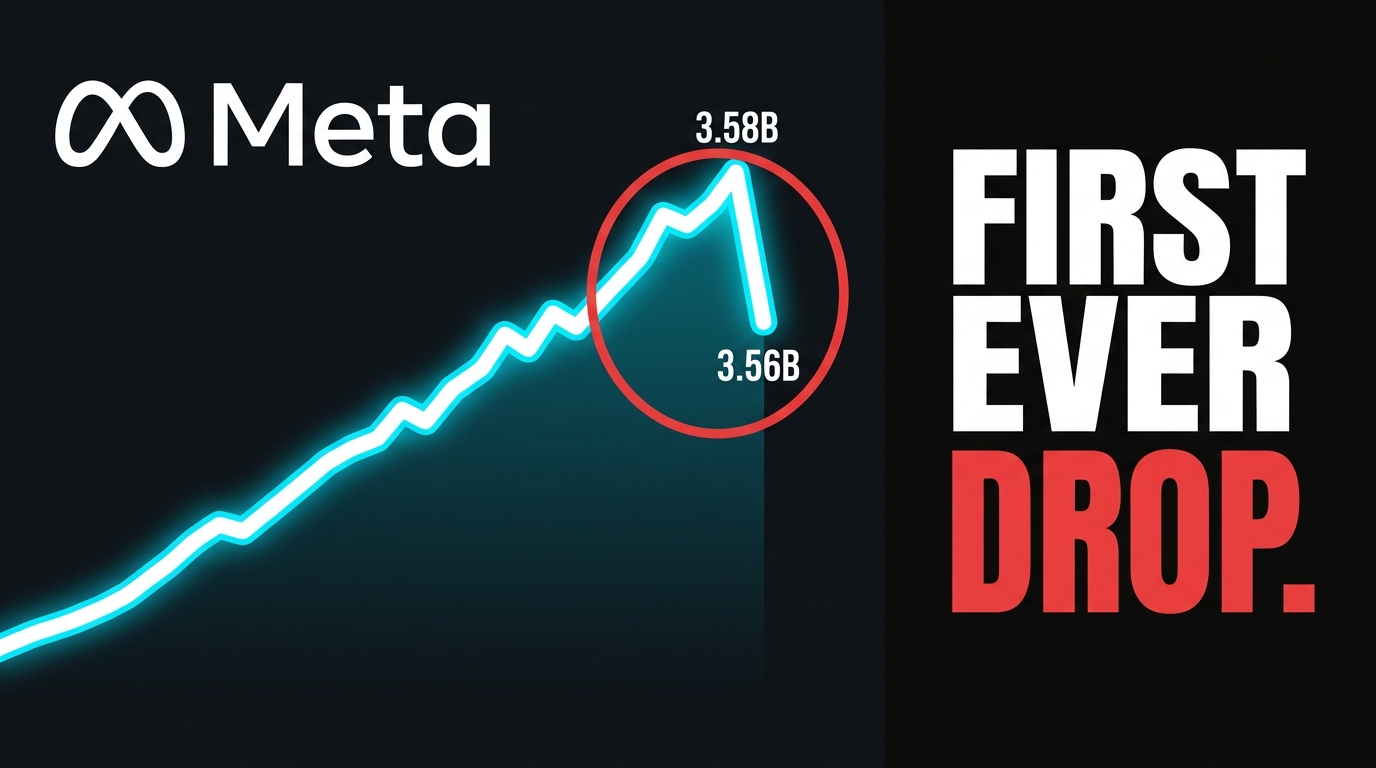
Family daily active people, Meta’s count of the users who open Facebook, Instagram, WhatsApp, or Messenger on an average day, came in at 3.56 billion for March 2026. The filing reports that as an increase of 4 percent year over year, and that year-over-year framing is the one it leads with. Compared to March 2025, the number is up. That is true, and it is the version of the number the release presents first.
Measured a different way, the picture inverts. In December 2025, that same combined daily metric stood at 3.58 billion, according to Meta’s most recent annual report. So from the fourth quarter of 2025 to the first quarter of 2026, the number of daily users across the family of apps fell. As far back as the reported series goes, that had not happened before. Not during the privacy scandals of 2018. Not through any prior quarter since Meta began publishing the combined figure. The metric had only ever risen, quarter after quarter, for years. This is the first sequential decline on record.
The filing offers a reason, and it is worth quoting exactly: “The slight decline in DAP on a quarter-over-quarter basis was driven by internet disruptions in Iran, as well as a restriction on access to WhatsApp in Russia.” So the company’s own explanation is that the decline came from a war and a government ban, both outside its control, and that absent those two events the number would likely have kept climbing.
The decline itself is small. December’s 3.58 billion to March’s 3.56 billion is a drop of roughly 20 million people, about six tenths of one percent. On its own, a rounding error against a base that size. If the story ended at the magnitude, there would be nothing here. The story is in the framing and in what a first of any kind signals for a company whose entire investment case rests on getting bigger.
What Meta’s user decline actually means
A tiny sequential dip is not, by itself, a crisis. The reason it is worth an article is the mechanism sitting behind it, and the mechanism is arithmetic, not scandal.
Consider what Meta’s own explanation implies. The company says the only forces that pushed the daily number down this quarter were an internet disruption in one country and an app ban in another. Take that at face value, which is reasonable, and follow it to its conclusion. When a service already reaches more than a third of the people alive on an average day, the events large enough to move that number lower are things like wars and national bans. Under ordinary conditions, the base barely grows, because there are not many people left on Earth who have not already been counted. Organic user growth, the engine that powered Meta for two decades, is approaching a ceiling defined by the size of the connected human population.
That is a very different situation from the one the market has priced for most of Meta’s life. For twenty years, the case for owning the stock included a simple assumption: more people every year, on more apps, seeing more ads. The daily user count rising was the visible proof that the assumption still held. This quarter, for the first time, that proof pointed the other way, and the only reason offered was geopolitical. It is hard to read that as anything but a company that has nearly run out of new people to add, with future user growth now hostage to events it does not control.
None of this means Meta is shrinking as a business. Revenue grew 33 percent. The point is narrower and more important: the part of Meta’s growth that came for free, from simply adding more humans to the network, looks close to finished. Whatever growth comes next has to come from somewhere else. Getting more money from each existing user, keeping them on the apps longer, or building an entirely new product. And as the next section shows, Meta has made a large and expensive bet on exactly that problem.
Meta’s capital expenditures for 2026 are set to nearly double
If the user ceiling is the disease, the spending is the treatment, and the size of the treatment is the second thing that unsettled investors.
Meta now expects capital expenditures of $125 billion to $145 billion in 2026, raised from a prior range of $115 billion to $135 billion. To put that in proportion, the company spent $72.22 billion on capital expenditures in all of 2025. The midpoint of the new range is close to double that figure, in a single year, and nearly all of it is aimed at AI: data centers, the specialized chips that fill them, and the power to run them. In the first quarter alone, capital expenditures reached $19.84 billion.
A range of $125 billion to $145 billion is larger than the entire annual revenue of all but a handful of companies in the S&P 500, committed over twelve months, to infrastructure whose payoff is still a projection rather than a line item. Meta generates enough cash to fund it without strain. What it does not yet have is proof that the spending converts into the growth its user numbers can no longer supply on their own.
There is also a mechanical consequence that will not show up this quarter but will show up soon, and it is the kind of thing a filing rewards you for thinking through. Capital spending does not just leave the bank account. It becomes depreciation, the accounting cost of those buildings and servers wearing out, spread across the following years. A near-doubling of capital expenditures today means a materially heavier depreciation line tomorrow, and that line presses directly on the same 41 percent operating margin that looked so healthy this quarter. Investors reacting to the guidance were not reacting to the record profit. They were pricing a business with a maturing user base and a capital budget set to roughly double, disclosed side by side in the same document.
That combination, not the profit, is the cleanest explanation for the stock’s move. A record quarter that a viewer would cheer, wrapped around two disclosures that a shareholder has to underwrite: growth that now depends on geopolitics, and a bill that has doubled.
Reality Labs losses: the $83 billion question
There is a third figure in the filing that deserves its own section, because it is the part of Meta that has been losing money on purpose for years, and the cumulative total has quietly reached a remarkable size.
Reality Labs, the division that builds virtual-reality headsets and smart glasses, reported revenue of $402 million for the quarter, down from $412 million a year earlier, against a loss from operations of $4.03 billion. The revenue line is the quieter tell here. Hardware sales actually fell year over year even as the company leaned harder into smart glasses and poured more money into the segment. A division losing more than $4 billion a quarter while its revenue slips is a harder thing to keep framing as a long-term bet, though the framing continues regardless.
The cumulative number is the one that stops people. Add up Reality Labs operating losses across the full years from 2020 through 2025, and the segment has lost $83.58 billion. Include the additional $4.03 billion from the first quarter of 2026 and the running total sits near $87.6 billion. That is a sum roughly the size of a large public company, spent over six years, on a product category that most people have never tried once. Management has consistently described this as a decades-long investment in the next computing platform. Six years and $87 billion in, the return remains a promise rather than a result.
It would be unfair to treat Reality Labs as the whole story, and it is not. The segment is a rounding choice against a business that earned $22.87 billion from operations in the quarter. But it belongs in any honest account of the filing for a simple reason: the same company that recorded a record profit, hit a user ceiling, and doubled its AI budget is also absorbing a multi-billion-dollar quarterly loss from a hardware bet that is not yet growing. All of it is in the same document. The headline carried one line of it.
Why did Meta stock drop after a record profit?
Put the pieces together and the market reaction stops looking strange and starts looking rational.
A viewer scanning headlines saw a record: net income up 61 percent, revenue up 33 percent, margins at 41 percent. A shareholder reading the filing saw three things the headline did not lead with. First, that the record profit was inflated by an $8.03 billion one-time tax benefit, and that stripping it out left earnings growth in the mid-teens rather than up 61 percent. Second, that the daily user base had declined sequentially for the first time in the company’s history, with the only explanation being events outside the company’s control. Third, that the capital budget for the year was set to nearly double, to as much as $145 billion, aimed at an AI payoff that is still a forecast.
Stock prices move on expectations, not on the past quarter in isolation. A record built partly on accounting, a growth engine showing its first ceiling, and a spending commitment of that scale together revise the story the market was telling itself. That is why the stock dropped when profit hit a record: the profit was never the concern. The concern was what the rest of the filing implied about the years ahead. Punishing a company for a record quarter looks irrational only until you read past the first line.
The 2022 precedent every Meta shareholder should remember
This is not the first time a Meta user number turned down and the market reacted before anyone finished reading the details.
In February 2022, when the metric that fell was Facebook’s daily active users reported on their own, Meta shares dropped about 26 percent in a single day and gave up close to $230 billion in market value, one of the largest one-day losses in corporate history at the time. The trigger then was the same category of event as the trigger now: a user count, long assumed to only rise, ticked down. The market’s reflex when a Meta engagement number turns is old and well established. A user figure declines, and investors stop to ask whether the growth story still holds.
The 2026 reaction was milder, and the reasons are instructive. This time the drop was in the single digits into the low double digits rather than 26 percent, in part because the headline profit gave investors something to hold onto, at least until they reached the tax footnote, and in part because the sequential decline was tiny and came with a clean geopolitical explanation. The pattern repeated, but at lower amplitude. What did not change is the market’s sensitivity to the direction of that number. For a company whose valuation has always leaned on growth, the first derivative of the user count carries more weight than almost any single figure on the income statement.
There is one more pattern worth naming, visible across the whole release rather than in any single line. Every comparison that rose is stated plainly and up front: revenue up 33 percent, ad impressions up 19 percent, price per ad up 12 percent, daily users up 4 percent year over year. The one that fell, the sequential user count, appears as a “slight decline” a clause later, wrapped in the reasons it was not the company’s doing. It is a defensible presentation, every number is disclosed, and it does show a consistent preference for leading with the version of a figure that flatters and disclosing the other version to readers who keep going.
The risks to the growth-ceiling thesis
Everything above builds toward a single reading: that Meta’s easy, population-driven growth is maturing, and the quarter marked the moment it became visible. That thesis could be wrong, or overstated, in several concrete ways, and an honest analysis has to sit with them.
The first risk is that the user dip really is one-off geopolitics and nothing more. The filing attributes the decline to Iran and Russia specifically, both plausibly temporary, and the metric was still up 4 percent year over year. If the disrupted users return next quarter and the sequential number resumes climbing, then this was a blip that got over-read, and the ceiling narrative was premature.
The second risk is that user count is the wrong metric to fixate on. Meta can grow engagement, the time each person spends and the ads each person sees, even if the raw count of daily users plateaus. AI-driven feed recommendations have been lifting time spent, and a flat user base with rising engagement per user can still produce years of revenue growth. A ceiling on people is not the same as a ceiling on the business.
The third risk is pricing power. The average price per ad rose 12 percent this quarter, which means Meta is extracting more revenue from the same inventory. As long as advertiser demand and ad pricing keep climbing, revenue can grow without a single new user, which weakens the argument that the user ceiling caps the company’s future.
The fourth risk is that the AI spending works. The $125 billion to $145 billion capital budget is the bet that a new growth engine can be built, and if even part of it pays off, whether through better ad targeting, new AI products, or infrastructure Meta can rent to others, the current worry about the user ceiling will look quaint in hindsight. Large, well-capitalized companies have converted heavy capital expenditure into durable advantage before.
The fifth risk is simply that runway remains in places this analysis underweights. WhatsApp monetization is early, emerging markets are not fully penetrated, and business messaging is a genuine and growing revenue line. The ceiling may be further away than one quarter’s sequential dip suggests.
None of these dissolve the core observation, which is that the free part of Meta’s growth is slowing and the company is spending heavily to replace it. But they are the reasons a reasonable investor could look at the same filing and stay bullish, and they belong in the record.
What to watch in Meta’s 2026 and 2027 filings
For readers who want to track whether the growth-ceiling reading holds up, a handful of specific, checkable signals will settle it over the next several quarters.
Watch the sequential daily user count. The single most important question is whether the March 2026 dip reverses. If daily active people return to sequential growth once the Iran and Russia disruptions fade, the ceiling thesis weakens considerably. If the number stays flat or keeps drifting down under normal conditions, the ceiling is real.
Watch the capital expenditure guidance. The 2026 range was already raised once, from $115-135 billion to $125-145 billion. Whether it rises again, holds, or is walked back will say a great deal about management’s own confidence in the AI payoff and about the pressure the spending is putting on the business.
Watch the depreciation line and its effect on operating margin. As the current wave of capital spending converts into depreciation over the next several years, the 41 percent operating margin will face real downward pressure. How much margin Meta gives up, and how quickly, is the clearest read on what the AI build is actually costing.
Watch Reality Labs revenue, not just its losses. The losses are steep but expected. The more revealing number is whether hardware revenue reverses its year-over-year decline as smart glasses scale. A segment that starts growing its top line is a different investment than one losing $4 billion a quarter on flat or falling sales.
Watch whether Meta actually passes Google in advertising revenue. The research firm eMarketer projects Meta will overtake Google in worldwide ad revenue for the first time in 2026. If that happens, it is strong evidence the core business still has room to run and can fund the AI bet on its own for years. If it slips, the pressure on the new spending intensifies.
Meta’s record profit was mostly a one-time tax benefit, and it arrived in the same filing that showed the company’s first-ever sequential drop in daily users and a capital budget set to nearly double, which is why the most profitable quarter in Meta’s history was also the one that made investors nervous.
Sources: Meta Platforms Q1 2026 earnings press release (Form 8-K, Exhibit 99.1); Meta Platforms Form 10-Q for the quarter ended March 31, 2026; Meta Platforms Form 10-K for fiscal year 2025; Meta Platforms Form 10-K for fiscal year 2022; eMarketer worldwide ad revenue projections. Stock price movements and the February 2022 comparison reflect market data as reported.
Frequently asked questions
Did Meta really have a record quarter in Q1 2026?
Yes and no. Meta’s net income of $26.77 billion was the highest quarterly profit in company history, and revenue of $56.31 billion grew 33 percent year over year. But roughly $8.03 billion of that profit came from a one-time income tax benefit. Excluding it, diluted earnings per share would have been $3.13 lower, at about $7.31, up roughly 14 percent rather than the reported 62 percent. So the operating business grew at a healthy but ordinary pace, and the record was substantially driven by the tax item.
Why did Meta’s stock drop after record earnings?
The market reacted to what the filing implied about the future rather than the headline profit. The record was inflated by a one-time tax benefit, the daily user base declined sequentially for the first time ever, and the company raised its 2026 capital expenditure guidance to as much as $145 billion. Together, those disclosures revised the growth story investors had been pricing, which is why the stock fell despite the record.
How much did Meta’s daily active users decline?
Family daily active people fell from 3.58 billion in December 2025 to 3.56 billion in March 2026, a sequential drop of about 20 million people, or roughly six tenths of one percent. It was the first sequential decline in the combined metric on record. Year over year, the number was still up 4 percent. Meta attributed the sequential decline to internet disruptions in Iran and a WhatsApp restriction in Russia.
What was Meta’s $8 billion tax benefit?
Meta recognized an $8.03 billion income tax benefit in the first quarter of 2026. It partially reverses a $15.93 billion non-cash tax charge the company recorded in the third quarter of 2025 following the enactment of the One Big Beautiful Bill Act. The benefit is a one-time accounting item tied to the change in tax law, not a result of the advertising business improving, and it drove the effective tax rate to negative 23 percent for the quarter.
How much is Meta spending on AI in 2026?
Meta guided to capital expenditures of $125 billion to $145 billion for 2026, raised from a prior range of $115 billion to $135 billion. That is close to double the $72.22 billion the company spent in 2025, with nearly all of the increase directed at AI data centers and the chips and power required to run them.
How much money has Reality Labs lost?
Reality Labs, Meta’s virtual and augmented reality division, lost $4.03 billion in the first quarter of 2026 on revenue of $402 million. Adding up the segment’s operating losses from 2020 through 2025 gives a cumulative loss of $83.58 billion, and including the first quarter of 2026 the running total is roughly $87.6 billion.