
Alphabet discloses the cost of being your default in plain sight, once a quarter. Almost nobody reads the line. A federal court did.
The 60-second version
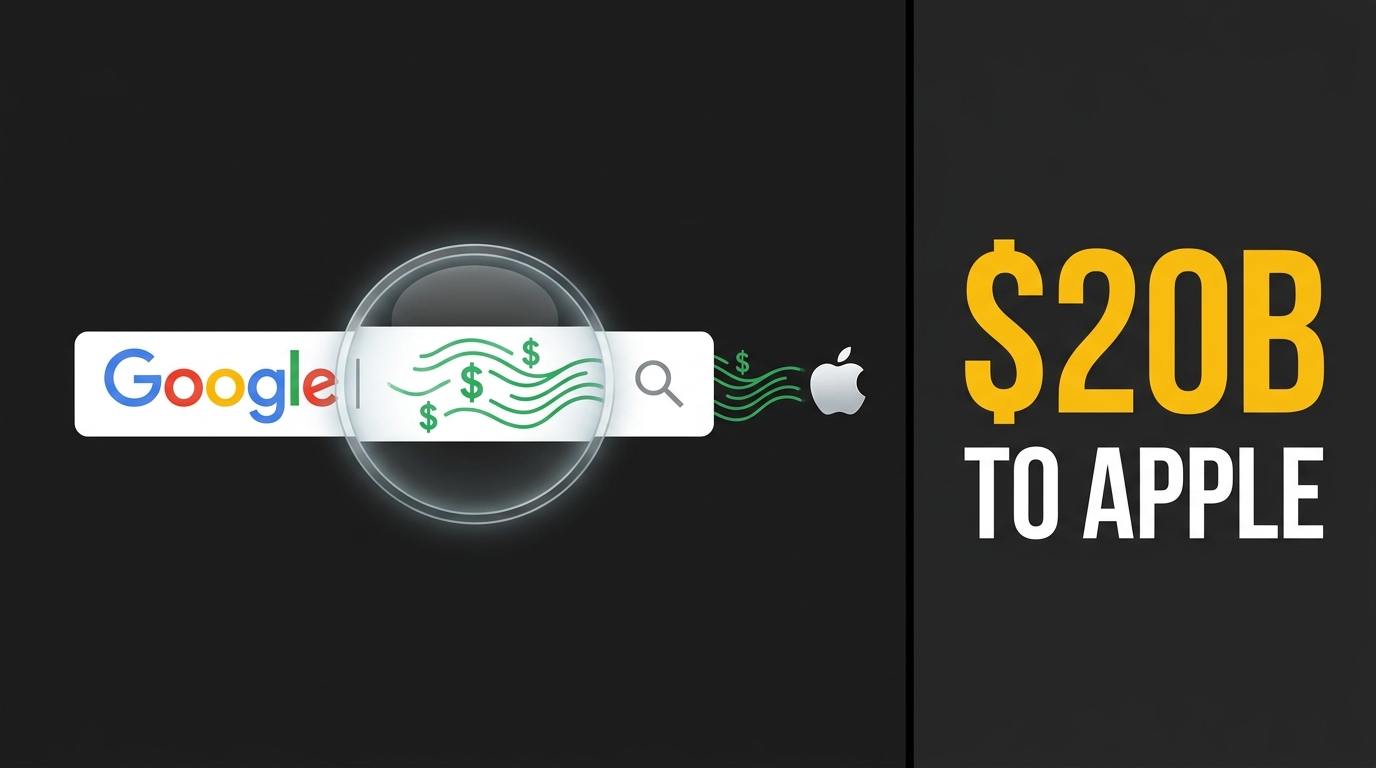
Every quarter, Alphabet reports a figure called traffic acquisition costs, the money Google pays other companies to keep searches flowing to Google. In the first quarter of 2026 it was $15.23 billion, which annualizes to more than $60 billion a year. The single largest piece of that spending is the Google-Apple search deal: roughly $20 billion in 2022, paid to Apple for one thing, being the default search engine on every iPhone, iPad, and Mac. That arrangement was found to be an illegal act of monopoly maintenance in 2024, and in 2025 a court ordered remedies that Google is now appealing hard. The reason Google is fighting is not really the Apple payment, and understanding why requires looking at what the payment has quietly been buying for twenty years.
Skip to the section that interests you most
The $15.23 billion line Alphabet does not discuss
Alphabet’s quarterly earnings releases are efficient documents. They lead with revenue, which in the first quarter of 2026 was $109.9 billion, up 22%. They highlight Google Cloud, up 63%. They quote the chief executive. What they do not dwell on is a line near the back of the supplemental tables labeled traffic acquisition costs, which for the quarter came to $15.23 billion. Alphabet disclosed the number, as it is required to, and then moved on, as it is entitled to. Both of those are choices.
That single quarter of spending is larger than the annual revenue of most public companies. Annualized, it runs past $60 billion. A year earlier the same line read $13.748 billion, which means the cost of simply remaining where Google already sits rose almost 11% in twelve months. For a company whose entire public story is that people choose it because it is the best, a rising annual bill to remain the pre-selected option is an odd thing to keep paying. It is also, on inspection, the most important line in the filing.
Before going further, it is worth pausing on what the figure actually represents, because the phrase is doing a lot of quiet work.
What traffic acquisition costs actually are
Traffic acquisition costs, or TAC, are the payments Google makes to third parties to route search queries and ad traffic to Google. They fall into two broad buckets. The first is distribution: payments to device makers, browser developers, and wireless carriers to make Google Search the default. The second is network: payments to the websites and apps in Google’s advertising network that display Google-served ads. The $15.23 billion combines both, so it would be wrong to describe the entire figure as the price of being the default. The distribution portion is the relevant one for this story, and within it, one payment towers over the rest.
The important thing about TAC is conceptual. It is the cost of not being chosen on the merits alone. A company with a genuinely unassailable product would, in theory, need to spend very little to remain the option people reach for. The size of Google’s TAC, and its steady growth, is the first hint that the search market does not work the way the tidy version suggests. The clearest evidence for that lies in a single agreement whose price was, until recently, a closely held secret.
The Google-Apple search deal, and the number that slipped out in court
In 2022, according to trial testimony from Apple’s own senior vice president of services, Eddy Cue, Google paid Apple roughly $20 billion. Not for hardware, not for a service, not for a partnership in any conventional sense. For default placement: the guarantee that when a user opens Safari on an iPhone, iPad, or Mac and types into the search bar, the results come from Google, before the user has expressed any preference at all. Judge Amit Mehta, who presided over the case, would later describe this agreement as the heart of the government’s argument, and the arithmetic explains why. That one check is roughly a third of Google’s entire global traffic-acquisition bill.
For years, the exact economics of the deal were invisible. The $20 billion does not appear in Alphabet’s securities filings. It does not appear in Apple’s. The public learned the structure the way it usually learns these things, by accident, in open court. During the 2023 trial, the University of Chicago economist Kevin Murphy, testifying as Google’s own expert, stated that Apple keeps 36% of the search advertising revenue Google generates through Safari. The figure had been confidential, and the number was spoken aloud before anyone could object. Sundar Pichai confirmed the following day that it was accurate. The 36% share was a secret right up until an economist said it into a microphone.
That combination, roughly $20 billion in absolute dollars and 36% of Safari search revenue as the sharing formula, is the core of the Google-Apple search deal. It is also the single most scrutinized commercial arrangement in the technology industry, because a court has now decided it was illegal.
How the payments got so large
The Apple relationship did not start at $20 billion, and it has not stopped climbing. The payment was around $18 billion in 2021, which by the spring of that year already worked out to more than $1 billion a month. Evidence introduced at trial indicated that in 2020, Google’s payments amounted to roughly 17.5% of Apple’s entire operating income, a striking figure for money that flows from a single deal and requires Apple to do essentially nothing except leave a default setting untouched.
Apple is the largest recipient but not the only one. Mozilla, the maker of Firefox, draws more than 80% of its revenue from the same Google default arrangement, which makes the browser that was born to check the last search monopoly financially dependent on the current one. Google also pays Samsung, other Android manufacturers, and carriers for placement across the ecosystem. The total spending on default status across all partners in 2021 was reported at roughly $26 billion, which is distinct from, and larger than, the Apple figure alone. Keeping those numbers straight matters, because they are frequently conflated.
The pattern across all of these deals is the same. Google is not buying a product or a service. It is buying the absence of a choice. And the escalating price suggests the company understands exactly how valuable that absence is.
Why a default is worth $20 billion
The obvious question is why a preinstalled setting commands a price this large. The answer is that in search, the default is close to destiny. The court that examined these agreements found that Google holds roughly 90% of the United States general search market, and that the Chrome default alone accounts for about 20% of all searches in the country. Defaults are stickier than people intuitively believe. The overwhelming majority of users never open settings, never evaluate alternatives, and never switch. Whoever controls the default controls the traffic, and in this market the traffic is the entire asset.
The most persuasive evidence that the default is the asset came from the only company that seriously tried to buy it away. According to Cue’s testimony, Microsoft offered Apple a far larger share of Bing’s search revenue, by some accounts approaching the entire amount, to make Bing the Safari default. Apple declined. Cue’s explanation was blunt: there was no revenue share at which Bing earned Apple more than Google, because Apple’s own customers would search less and abandon the experience the moment quality dropped. Microsoft’s problem was never the size of its offer. It was that Bing was Bing. A larger percentage of an inferior product still loses, and Apple, which is not in the business of leaving money on the table, kept the incumbent.
So the payments make sense as a defensive expense. But defense against what, exactly? A company with 90% share and a product rivals cannot match would seem to have little to defend. The full logic only becomes clear when you ask what the default actually produces, rather than what it costs.
What the money actually buys: the data flywheel
Here is the part that reframes the entire arrangement. The $20 billion to Apple is not rent on a piece of screen real estate. It is a subscription to a data stream.
Every search is a labeled event. A user types a query, sees a set of results, clicks one, sometimes returns and clicks another, sometimes rephrases entirely. Each of those actions is a signal about which answers satisfy which questions. Run that process across roughly 90% of American search for two decades and the accumulated result is something no competitor can purchase at any price: a continuously updated, planetary-scale record of what people are trying to find and which responses actually work. That record is what makes Google’s results good. Good results retain users. Retained users generate more signals. The signals improve the results. The loop compounds, and it has been compounding since the early 2000s.
Seen this way, the default payments are not marketing spend. They are fuel. The queries that flow from being the default on the world’s most valuable phones are the raw input to the loop, and the loop is the actual moat. Google’s advantage was never only that its ranking algorithm was cleverer. It was that Google had something rivals structurally could not obtain, which is everyone’s behavior, at scale, forever. Cut off the queries and the loop slows. This is why the Apple payment keeps rising even though Google’s market position looks secure. The company is not defending its share of a static market. It is defending the input to a self-reinforcing system, and it understands that the system is only as strong as the volume of data feeding it.
This is also why the moat resists the obvious counterattack, which is simply to outspend Google. A competitor with unlimited capital could match the engineering, buy the servers, and even outbid Google for a default slot. What money cannot buy is time. The behavioral record that makes Google’s results good was assembled query by query over two decades, and there is no version of it available for purchase, because no other company was the default while it was being created. A rival starting today would need not just money but years of being the place people search, which is precisely the position the payments to Apple and others were designed to prevent anyone else from ever occupying.
Which is precisely what makes the legal case so consequential, because a court has now decided to do something about the loop.
The Google search monopoly ruling, explained
The legal story runs in two acts. In August 2024, Judge Mehta ruled that Google had violated the Sherman Act by illegally maintaining its monopoly in general search through these exclusive default agreements. The finding was narrow in one sense and sweeping in another: the court did not say Google’s product was bad, and in fact acknowledged its quality. It said Google had used its payments to foreclose competition, denying rivals the scale they would need to ever catch up. Liability, in other words, turned almost entirely on the second half of the story, the payments, not the first, the product.
The second act was the remedies phase, decided in September 2025. Here the outcome was milder than the government wanted, and the details matter. Google was not broken up. The court declined to force a sale of Chrome or Android, the two structural remedies the Justice Department had pushed hardest for. It also declined to ban the default payments outright, reasoning that cutting them off abruptly would inflict serious harm on Apple, Mozilla, and the broader ecosystem that has come to depend on them. The practical effect is that Google can still pay to be the default. What it can no longer do is make those deals exclusive or lock them in for more than twelve months, which hands rivals an annual window to compete for placement. The court also established a technical committee to oversee compliance, set the judgment to run for six years, and ordered Google to syndicate its search results and text ads to competitors on commercial terms while they build their own capacity.
There is an irony worth naming plainly. The court’s answer to the problem of Google paying too much for exclusive defaults was to let Google keep paying for defaults, only non-exclusively. That may prove to be a meaningful constraint, or it may prove to be a speed bump. But it is not the part of the ruling that Google is fighting hardest, and the part it is fighting reveals what the company actually fears.
The remedy that actually threatens Google: data sharing
The remedy with real teeth is aimed straight at the loop. The court ordered Google to make portions of its search index and its user-interaction data available to qualified competitors, though pointedly not its advertising data. In the court’s own framing, the purpose was to deny Google the fruits of its unlawful conduct.
Google will have to make available to Qualified Competitors certain search index and user-interaction data, though not ads data.
Read against the data-flywheel logic above, this is the remedy that matters. For twenty years the loop had no serious challenger, and the one input rivals could never obtain was real-world search behavior at scale. A court order to share that data is, in effect, an order to hand competitors the missing ingredient. It does not touch the Apple payment directly. It targets what the Apple payment produces.
And here is where the story becomes unmistakably a 2026 story rather than a 2024 one. The competitive landscape changed underneath the case. Generative AI arrived, and tens of millions of people now put their questions to ChatGPT, Perplexity, and Claude instead of a search box. The court acknowledged as much in its opinion, and its data-sharing remedy contemplates AI companies among the potential recipients. The implication is enormous: the firms best positioned to challenge Google, the ones building AI-native search, could receive by court order the exact behavioral data they have been unable to accumulate on their own.
Google’s response has been to fight this provision harder than anything else in the entire case.
The appeal, and why both sides are unhappy
On May 22, 2026, Google filed its appeal with the United States Court of Appeals for the D.C. Circuit. The brief argues that Google won search “fair and square” and did nothing that harmed the competitive process, the familiar contention that dominance earned through a superior product is not an antitrust violation. On the data-sharing remedy specifically, Google got pointed. It asked the court to exclude generative-AI firms like OpenAI entirely, arguing they did not exist during the period the case covered and have no need, in Google’s phrasing, to “free-ride on Google’s success.” The subtext is not subtle. Google is far less worried about sharing data with the search engines of 2010 than with the AI companies of 2026.
The government is unhappy from the opposite direction. In February 2026, the Justice Department and a coalition of states cross-appealed, arguing the remedies were too lenient, in part precisely because they still permit Google to pay for default placement at all. So both sides are now appealing the same ruling in opposite directions, which is a fair indication of how unsettled the outcome remains.
Google’s appeal leans heavily on precedent, and specifically on United States v. Microsoft, the last landmark technology monopoly case, in which a court found liability but a court-ordered breakup eventually dissolved into a settlement. The implied argument is that aggressive remedies tend to unravel on appeal and that punishing a company for competing vigorously is bad law. It is a telling choice of precedent: Google’s strongest historical analogy is the last time the government won a monopoly case and then largely did not collect. Investors appear to find the logic convincing. Alphabet’s stock has risen sharply since the August 2024 liability finding, and the market has broadly treated the entire proceeding as a manageable weather event rather than an existential storm. Oral arguments are expected to run into late 2026 or early 2027, with a decision likely twelve to eighteen months after that, so the question is far from resolved.
The other side of the deal: what it means for Apple
The Google-Apple search deal is usually told as a Google story, but it is at least as important to Apple, and the numbers explain why. The roughly $20 billion a year is close to pure profit. Apple incurs almost no cost to earn it, because the money arrives simply for leaving a default setting pointed at Google. Analysts have long estimated that the payment accounts for a meaningful share of Apple’s high-margin Services segment, the division Apple has spent years persuading Wall Street to value like a recurring-revenue business rather than a hardware maker. Shrink that payment and the Services growth story takes a visible hit, which is why Apple’s stock tends to react to developments in a Google antitrust case that is not, on its face, about Apple at all.
This creates an awkward alignment. Apple is one of the few companies on earth with the resources, the distribution, and the technical talent to build a credible search competitor. Instead, it is paid handsomely not to. The arrangement removes Apple as a potential challenger and, in the court’s view, helped foreclose the market to everyone else. It also leaves Apple exposed, because roughly $20 billion of annual profit now depends on the outcome of litigation Apple does not control. Apple has quietly signaled that it is exploring alternatives, from expanded on-device search features to potential arrangements with AI providers. Any serious move by Apple to reduce that dependence would be one of the clearest early signs that the ground is genuinely shifting, and it would be visible long before the courts issue a final word.
The risks to the default-as-data thesis
The argument that the payments are really about data, and that the data-sharing remedy is therefore the decisive front, is a strong reading of the evidence. It is not the only possible reading, and intellectual honesty requires stating where it could be wrong.
First, Google’s search may simply be the best, and the payments may be genuine insurance rather than the true cause of its dominance. The trial itself conceded the product’s quality. If users would overwhelmingly choose Google even without default placement, then the payments are less load-bearing than the thesis suggests, and sharing data changes less than expected.
Second, the data-sharing remedy may be substantially weakened before it ever bites. It could be stayed pending appeal, narrowed by the technical committee, or hollowed out by the exclusion of advertising data and by privacy and trade-secret carve-outs that Google will litigate at every step. A remedy on paper is not the same as data actually flowing to a rival.
Third, the moat may be more exogenously threatened than the case can address. If AI search erodes Google’s dominance regardless of what any court orders, then the data-sharing remedy is fighting a battle that technology is already deciding, and the legal outcome matters less than the behavioral shift.
Fourth, data may be a weaker moat than the flywheel framing implies. Modern models exhibit diminishing returns to additional click data, and it is at least arguable that the marginal value of Google’s proprietary behavioral record is lower today than it was a decade ago. If so, handing rivals the data helps them less than Google fears and less than critics hope.
Fifth, the appeal could reverse liability altogether. If the D.C. Circuit or, eventually, the Supreme Court accepts the “fair and square” argument and the Microsoft analogy, the entire remedial structure, including the data-sharing order, could vanish, leaving the arrangement intact.
What to watch in the next 12 to 18 months
The case will resolve slowly, but several concrete signals will indicate which way it is breaking.
Watch the D.C. Circuit’s treatment of the data-sharing stay, and in particular whether AI firms are carved out. That single question, more than the fate of the Apple payment, determines whether the remedy has real force.
Watch how “qualified competitor” is defined in practice, and what data actually flows to whom. If OpenAI or Perplexity begin receiving real search and interaction data, the competitive picture shifts quickly. If the definition proves narrow and the data trickle is thin, little changes.
Watch Alphabet’s traffic-acquisition-costs line in the coming quarters. If the new twelve-month, non-exclusive rule alters the Apple negotiation, it should eventually show up in the number. A continued steady climb suggests business as usual; a break in the trend suggests the remedy is being felt.
Watch Apple. Roughly $20 billion a year of high-margin revenue is now subject to legal uncertainty, and Apple has options, from building its own search capability to striking a deal with an AI provider. Any move Apple makes to reduce its dependence on the Google payment is a leading indicator.
Watch Google’s own AI search rollout and whether general search share holds as user behavior shifts toward conversational answers. The company is defending a data flywheel at the exact moment the front door of search is changing shape, and how it navigates that transition may matter more than the appeal.
Google did not win search only on quality; it paid, and keeps paying, tens of billions a year to ensure most people never see the alternatives, and the data those payments generate is now the one asset a court has ordered it to share.
Sources: Alphabet Inc. Q1 2026 earnings release (8-K, filed April 29, 2026); United States v. Google LLC liability opinion, 747 F. Supp. 3d 1 (D.D.C. 2024) and remedies opinion (September 2025); trial testimony of Eddy Cue and Kevin Murphy (2023); Google’s D.C. Circuit appeal brief (May 22, 2026); Justice Department and states cross-appeal (February 2026); contemporaneous reporting by CNBC, Bloomberg, MacRumors, and Courthouse News.
Frequently asked questions
How much does Google pay Apple to be the default search engine?
Roughly $20 billion in 2022, according to trial testimony from Apple executive Eddy Cue. The figure has grown over time, from around $18 billion in 2021, and the deal is structured as a revenue share in which Apple keeps 36% of the search advertising revenue Google earns through Safari. The exact figure for more recent years has not been separately disclosed.
Why does Google pay Apple so much?
Because being the default search engine on Apple devices generates an enormous volume of searches, and those searches produce both advertising revenue and the behavioral data that keeps Google’s results ahead of competitors. The default is valuable less as screen placement than as a data source, which is why the payment is so large and keeps rising.
Is the Google-Apple search deal illegal?
A federal court ruled in August 2024 that Google’s use of exclusive default agreements, including the Apple deal, was an illegal act of monopoly maintenance under the Sherman Act. The 2025 remedies ruling did not ban the payments outright but prohibited exclusivity and multi-year lock-ins. Google is appealing, so the final legal status is not settled.
Did Google lose the antitrust case?
Google lost on liability in 2024, meaning the court found it had illegally maintained a search monopoly. On remedies in 2025, the outcome was more favorable to Google than the government sought: no breakup, no forced sale of Chrome, and continued permission to pay for placement, subject to new limits. Both sides are appealing.
Does the ruling affect ChatGPT or OpenAI?
Potentially, yes. The remedies include an order for Google to share search and user-interaction data with qualified competitors, and the court’s framing contemplates AI companies among the recipients. Google is specifically fighting to exclude firms like OpenAI from receiving that data, which is one of the most contested issues on appeal.
What are traffic acquisition costs?
Traffic acquisition costs are the payments Google makes to other companies to send search and ad traffic its way, including payments to device makers and browsers for default placement and to advertising-network partners. In the first quarter of 2026, Alphabet reported $15.23 billion in traffic acquisition costs, which annualizes to more than $60 billion a year.
Will Google have to sell Chrome?
Not under the current ruling. The Justice Department asked the court to force a sale of Chrome, but the 2025 remedies decision declined to order any breakup, including a Chrome divestiture. The government is appealing that decision as too lenient, so a forced sale is not entirely off the table, but it is not part of the remedies as they stand today.
How long will the Google antitrust appeal take?
The appeal was filed in May 2026, with oral arguments expected in late 2026 or early 2027 and a decision likely twelve to eighteen months after that. A further appeal to the Supreme Court is possible from either side, which could extend the timeline considerably. In practical terms, the final shape of the remedies may not be settled for years.